Full Calendar
THIS DAY IN U.S. MILITARY HISTORY • FEBRUARY 16 1862 U.S. Army American Civil War

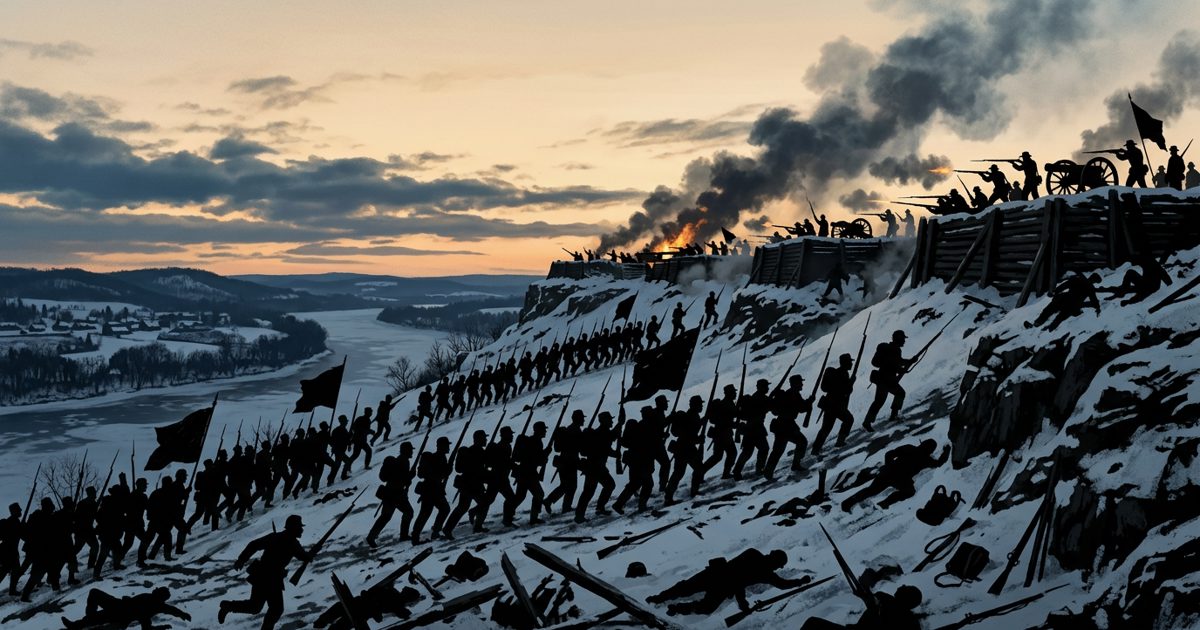
Grant Demands Unconditional Surrender at Fort Donelson

Brigadier General Ulysses S. Grant captures over twelve thousand Confederate troops in Tennessee, opening the Cumberland River and forcing the evacuation of Nashville.
Grant Demands Unconditional Surrender at Fort Donelson

Brigadier General Ulysses S. Grant consolidated Union lines around the earthworks of Fort Donelson on the frozen banks of the Cumberland River. Confederate forces under Brigadier General John B. Floyd had attempted a desperate breakout the previous morning, opening an escape corridor along the Forge Road toward Nashville. Grant arrived from a conference with wounded Flag Officer Andrew H. Foote, assessed the disarray on his right flank, and ordered an immediate counterattack against the weakened Confederate right wing. Union troops under Brigadier General Charles F. Smith breached the outer entrenchments before nightfall, sealing the garrison inside the fortified perimeter.

Confederate commanders held a chaotic midnight council inside the Dover Hotel as freezing temperatures crippled their exhausted soldiers. Generals Floyd and Gideon J. Pillow abandoned their commands and fled across the river on steamships, while cavalry colonel Nathan Bedford Forrest led his troopers through flooded marshland to safety. Brigadier General Simon Bolivar Buckner remained behind to negotiate capitulation terms with his prewar friend. Buckner dispatched a courier at daybreak requesting an armistice and the appointment of commissioners to settle surrender terms.

Grant drafted an immediate reply refusing any terms other than an unconditional and immediate surrender, warning that he would move upon the Confederate works at once. Buckner accepted the harsh demand, yielding Fort Donelson, sixty-five artillery pieces, and more than twelve thousand Confederate prisoners of war. Northern newspapers widely circulated the ultimatum, giving Grant the popular nickname Unconditional Surrender Grant and prompting President Abraham Lincoln to promote him to major general of volunteers. Union gunboats and transports swiftly advanced up the Cumberland River, compelling Confederate forces to evacuate Nashville without firing another shot.

CHRONOLOGICAL RECORD

February 16 Across U.S. Military History

9 Verified Events
1804 U.S. Navy Landmark Event • First Barbary War

Stephen Decatur Burns Frigate Philadelphia in Tripoli

Lieutenant Stephen Decatur led eighty volunteers aboard the captured ketch Intrepid into Tripoli harbor under the guise of a distressed merchantman flying British colors. Decatur and his boarding party stormed the captured frigate USS Philadelphia, eliminated the enemy guards, and set the warship ablaze before escaping without casualties under heavy harbor fire.

1864 U.S. Navy • American Civil War

Union Gunboats Bombard Confederate Fort Powell

Rear Admiral David G. Farragut initiated the preliminary naval campaign against Mobile Bay by ordering federal gunboats to bombard Fort Powell at Grants Pass. The double-ender gunboat USS Octorara, the converted ferry USS J.P. Jackson, and six mortar schooners pounded the Confederate masonry redoubt to sever supply lines between Mobile and western water approaches.

1926 U.S. Coast Guard • Interwar Era

Congress Authorizes Permanent Coast Guard Academy Campus

Congress passed legislation authorizing the Secretary of the Treasury to secure land in New London, Connecticut, for a permanent United States Coast Guard Academy. The statute appropriated 1.75 million dollars for construction, transitioning the service from aging training barques and temporary shore facilities into a modern officer training institution.

1945 U.S. Army Landmark Event • World War II

Paratroopers Land on Corregidor in Operation Topside

Transport aircraft of the 317th Troop Carrier Group dropped paratroopers of the 503rd Parachute Regimental Combat Team directly onto the rocky heights of Topside on Corregidor. Reinforced infantry from the 34th Infantry Regiment landed simultaneously on San Jose Beach, initiating a brutal combined assault that seized control of Malinta Hill and trapped the five-thousand-man Japanese garrison.

1945 U.S. Navy Landmark Event • World War II

Task Force 58 Launches Historic Tokyo Air Strikes

Vice Admiral Marc A. Mitscher guided Task Force 58 into waters sixty miles off Honshu to launch the first carrier-based air offensive against the Japanese home islands since 1942. American naval aircraft flew continuous fighter sweeps over metropolitan Tokyo, destroying hundreds of Japanese aircraft and neutralizing enemy air installations prior to the amphibious invasion of Iwo Jima.

1951 U.S. Navy Landmark Event • Korean War

United Nations Fleet Begins Siege of Wonsan

Warships of the United Nations task force initiated the blockade of Wonsan Harbor on the eastern coast of North Korea under United States Navy command. American cruisers and destroyers maintained an unbroken naval cordon and continuous shore bombardment for 861 days, preventing communist forces from utilizing the port and diverting thousands of hostile soldiers from the front line.

1953 U.S. Marine Corps • Korean War

Captain Ted Williams Survives Crash at Suwon Airfield

Marine Captain Theodore S. Williams piloted an F9F Panther jet on a combat strike against a hostile training facility south of Pyongyang when anti-aircraft fire punctured his hydraulics and fuel lines. Williams refused to eject, nursed his burning aircraft back to Suwon Air Base, and completed a wheels-up belly landing at 150 miles per hour before scrambling clear of the wreckage.

1969 U.S. Army • Vietnam War

Lieutenant Gary Miller Smothers Grenade in Binh Duong

Lieutenant Gary L. Miller led a reconnaissance patrol from Company A, 1st Battalion, 28th Infantry Regiment through dense vegetation in Binh Duong Province when hostile fire wounded him. Hostile fighters threw a grenade into the midst of his patrol, prompting Miller to throw his body over the weapon and absorb the blast, an action that earned him the Medal of Honor.

2006 U.S. Army • Global War on Terror

Army Decommissions Final Mobile Army Surgical Hospital

Army medical personnel held a formal ceremony in Muzaffarabad, Pakistan, to decommission the 212th Mobile Army Surgical Hospital. The unit had deployed to provide emergency relief following the 2005 Kashmir earthquake, and its deactivation concluded sixty-one years of MASH service across the Second World War, Korea, Vietnam, and Iraq as modern Combat Support Hospitals assumed the mission.

WEAPONS AND TECHNOLOGY 1960

Nuclear Submarine Triton Begins Submerged Global Voyage

Captain Edward L. Beach steered the nuclear-powered radar picket submarine USS Triton away from the pier at New London, Connecticut, under official orders for an ordinary shakedown cruise. Triton was the largest and most expensive submarine in the world, measuring 447 feet in length and displacing nearly eight thousand tons. Secret directives from the Navy Department designated the mission as Operation Sandblast, ordering Beach to complete the first fully submerged circumnavigation of the globe. Beach revealed the true mission to his two-hundred-man crew once the vessel cleared coastal waters and dove into the deep Atlantic.

Triton utilized two S4G nuclear reactors to maintain high submerged speeds without surfacing for air, mirroring the historic sixteenth-century voyage of Ferdinand Magellan. Scientific technicians aboard the vessel gathered gravimetric, oceanographic, and bathymetric data while testing long-term crew psychology in continuous sealed isolation. The submarine crossed the equator four times and completed the 26,723-nautical-mile circuit in sixty days, returning safely to port on April 25 without broaching the surface. Operation Sandblast confirmed that American nuclear submarines possessed unlimited global endurance, validating the operational concept for the upcoming deployment of Polaris ballistic missile submarines.