Full Calendar
THIS DAY IN U.S. MILITARY HISTORY • FEBRUARY 18 1945 U.S. Army World War II

Tenth Mountain Division Scales the Cliffs of Riva Ridge

Elite American mountain infantry launched a silent night climb up sheer Apennine cliffs to crack the German Gothic Line in northern Italy.
Tenth Mountain Division Scales the Cliffs of Riva Ridge

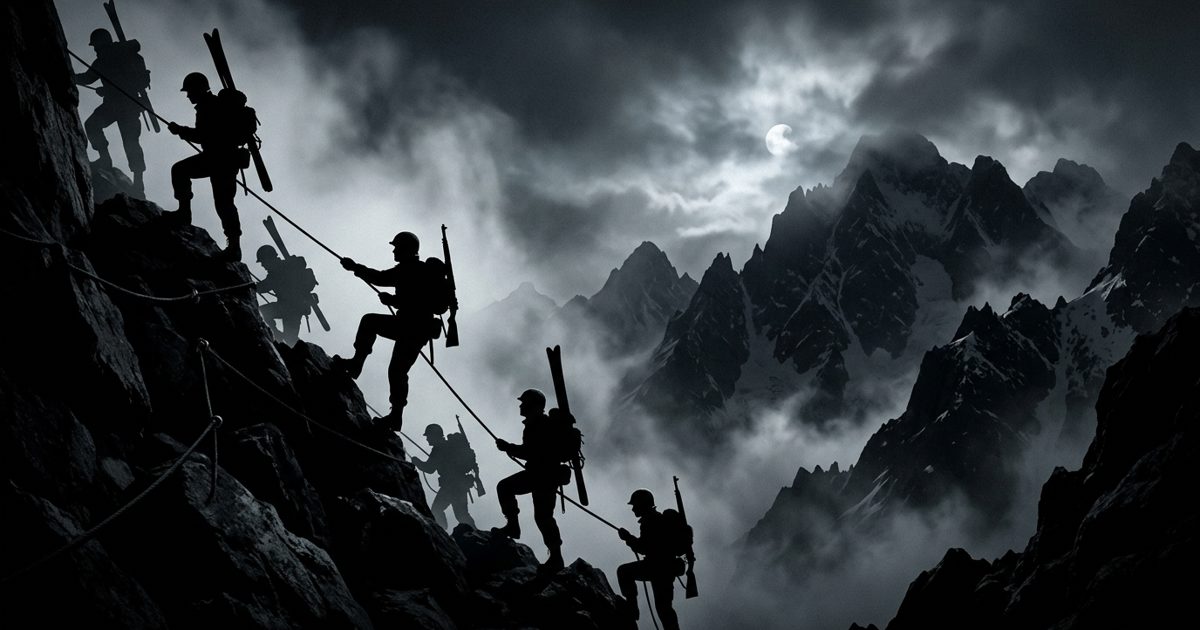
Soldiers from the 86th Mountain Infantry Regiment assembled at the base of the jagged Monte Belvedere massif in the Northern Apennines. German artillery observers atop the 1,500-foot precipice known as Riva Ridge had directed punishing fire against American positions for months. Major General George P. Hays realized that capturing Monte Belvedere required neutralizing these observation posts first. Seven hundred men from the regiment moved through freezing fog with climbing ropes, pitons, and stripped gear to attempt an ascent that the German defenders deemed impossible. Strict orders forbade gunfire, requiring men to rely entirely on cold steel to maintain total tactical surprise.

Mountaineers climbed four separate cliff routes in near-total silence throughout the frozen night. Men hauled heavy weapons and telephone wire up ice-sheathed ledges while relying on fixed safety ropes to avoid plunging into the ravines below. Patrols reached the summit line just before dawn without alerting the German 232nd Infantry Division encampments above. Surprise proved absolute when the Americans swarmed over the crest, overwhelming dugouts before the defenders could organize a cohesive perimeter. Several desperate German counterattacks struck the ridge during the morning, but defensive fire and close combat repulsed every push.

Daylight enabled combat engineers from the 126th Mountain Engineer Battalion to erect an 1,800-foot aerial tramway directly to the captured peaks. This cable system slashed casualty evacuation times from three agonizing hours down to five minutes and hauled critical ammunition directly to front-line fighting holes. Control of Riva Ridge stripped the German High Command of its eyes across the valley and cleared the flank for the assault on Monte Belvedere the next evening. Casualties among the assault companies remained remarkably light during the initial cliff ascent, with only one man wounded. The 10th Mountain Division secured the entire ridge system by dusk, opening the gateway for Fifth Army to break out into the Po Valley.

CHRONOLOGICAL RECORD

February 18 Across U.S. Military History

8 Verified Events
1815 Joint Service Landmark Event • War of 1812

President James Madison Proclaims Treaty of Ghent

President James Madison issued a public proclamation declaring the Treaty of Ghent fully ratified, officially ending the War of 1812 between the United States and Great Britain. The document reinstated prewar borders and freed American maritime trade from Royal Navy blockades. Both nations ordered all active naval squadrons and frontier posts to cease hostilities immediately.

1846 U.S. Navy • Antebellum Era

Navy Department Replaces Larboard With Port Terminology

Secretary of the Navy George Bancroft issued a general order prohibiting the term larboard aboard all American warships. Confusion between the similar-sounding commands larboard and starboard had caused costly navigational errors and collisions in heavy weather. Bancroft directed officers and sailors to substitute the word port for all helm commands and official log entries.

1865 U.S. Army Landmark Event • Civil War

Union Troops Enter Surrendered Cradle of Secession

Brigadier General Alexander Schimmelfennig accepted the formal surrender of Charleston, South Carolina, following the evacuation of Confederate forces under Lieutenant General William Hardee. Soldiers of the 21st United States Colored Troops and the 55th Massachusetts Infantry marched into the city to establish martial law. Union detachments immediately raised the national colors over abandoned harbor batteries and extinguished civilian fires.

1918 U.S. Army Air Service • World War I

Lafayette Escadrille Enters American Expeditionary Forces Service

Pilots of the renowned Lafayette Escadrille completed their official induction into the United States Army Air Service as the 103rd Aero Squadron. Ground personnel assumed maintenance of the unit Spad VII pursuit aircraft at La Noblette airfield in France. The transfer integrated veteran American combat flyers directly into the American Expeditionary Forces to fly frontline combat patrols.

1942 U.S. Navy • World War II

Heavy Gale Wrecks Twin Warships off Newfoundland

Destroyer USS Truxtun and cargo ship USS Pollux ran aground against jagged cliffs during a blinding blizzard off the Burin Peninsula. Mountainous surf tore both hulls apart within hours, claiming the lives of 203 American sailors. Local fluorspar miners lowered ropes down sheer 200-foot walls to haul 186 freezing survivors up the rocky cliffs to safety.

1944 U.S. Navy Landmark Event • World War II

Fast Carrier Task Force Concludes Operation Hailstone

Vice Admiral Marc Mitscher concluded Operation Hailstone after two days of devastating carrier strikes against the Japanese fortress at Truk Lagoon. Strike aircraft completed the first radar-guided night bombing runs in carrier history before noon. The operation sank two cruisers, four destroyers, and over thirty support vessels while destroying more than 250 enemy aircraft.

1955 Joint Service • Cold War

Operation Teapot Nuclear Tests Open in Nevada

Bombardment aircraft delivered the Wasp nuclear weapon over Yucca Flat, detonating a 1.2-kiloton airburst to inaugurate Operation Teapot at the Nevada Test Site. Armored columns from Exercise Desert Rock VI advanced to within 900 meters of ground zero beneath the rising cloud. Military evaluators measured blast resistance on reinforced concrete bunkers and tactical communications gear.

1966 U.S. Army Landmark Event • Vietnam War

Specialist Four Daniel Fernandez Shields Ambushed Squad

Specialist Four Daniel Fernandez rallied his trapped reconnaissance patrol after an ambush near Cu Chi pinned down American forces under heavy machine gun fire. An enemy grenade landed amid wounded soldiers during attempts to establish a defensive perimeter. Fernandez threw his body over the live munition to shield four comrades from the detonation, earning the Medal of Honor posthumously.

NAVAL WARFARE 1991

Persian Gulf Minefields Test American Damage Control

Iraq deployed hundreds of Soviet-designed moored contact mines across the northern Persian Gulf to disrupt coalition naval operations during Operation Desert Storm. Amphibious assault ship USS Tripoli served as the flagship for the airborne mine countermeasures task force, guiding minesweeping vessels through restricted shipping lanes. Shockwaves shuddered through the warship at 0436 hours when a naval mine detonated against the starboard bow below the waterline. Blast pressure ripped a 16-by-20-foot hole in the outer hull and flooded six auxiliary compartments. Damage control parties contained the progressive flooding within minutes, allowing the flight deck to maintain continuous MH-53 helicopter sweeps.

Cruiser USS Princeton struck two Italian-made bottom-influence mines less than three hours later while providing anti-air warfare coverage ten miles away. Dual underwater explosions cracked the cruiser superstructure, ruptured main fuel tanks, jammed the port rudder, and caused severe electrical failures. Princeton crew members extinguished multiple interior blazes and restored primary fire control radars within fifteen minutes despite substantial structural distortion. Repair tenders in Bahrain stabilized both vessels before drydock overhauls in Dubai returned the cruiser to operational status under its own steam.