Full Calendar
THIS DAY IN U.S. MILITARY HISTORY • FEBRUARY 19 1945 U.S. Marine Corps World War II

Marines Assault the Black Volcanic Sands of Iwo Jima

The 4th and 5th Marine Divisions endure murderous crossfire on D-Day to launch Operation Detachment in 1945.
Marines Assault the Black Volcanic Sands of Iwo Jima

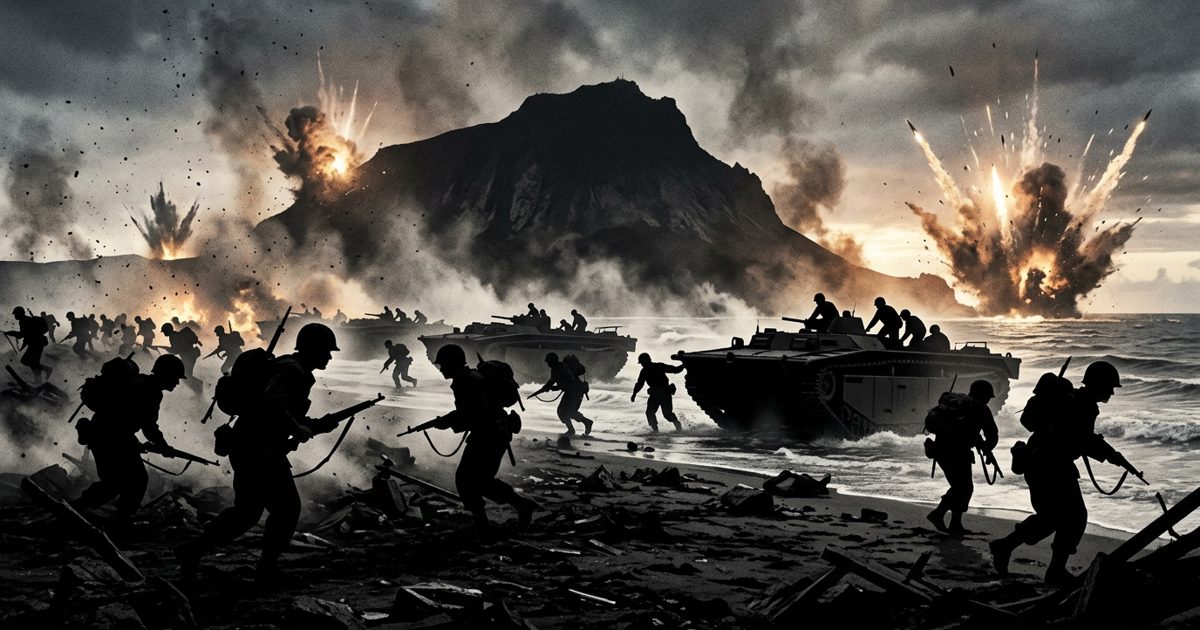
Battleships and heavy cruisers of Task Force 54 unleashed naval salvos against the fortified volcanic slopes of Iwo Jima at dawn on February 19, 1945. Hundreds of amphibious tractors churned across choppy surf toward the designated eastern landing beaches, delivering thirty thousand assault troops of the 4th and 5th Marine Divisions. Landing craft slammed onto the beaches under the brooding profile of Mount Suribachi, where soft black volcanic ash immediately stalled tracked vehicles and infantry boots. Japanese defenders commanded by Lieutenant General Tadamichi Kuribayashi held their fire until the shoreline became congested with men and machinery.

Artillery, mortars, and interlocking machine guns suddenly saturated the landing terraces, trapping thousands of Marines in exposed fire lanes. Shrapnel and small-arms fire swept the black dunes as company commanders rallied scattered squads to establish defensive perimeters. Marines utilized flamethrowers and satchel charges to eliminate concealed concrete bunkers built into the terraces, inching forward yard by bloody yard. Gunnery Sergeant John Basilone led his machine-gun section through intense mortar barrages to knock out a Japanese blockhouse before falling in action near Motoyama Airfield Number One.

Assault units secured a tenuous foothold across the southern beaches by nightfall despite suffering over two thousand casualties on the first day. Transports offshore continued landing artillery batteries and tanks through the night to reinforce the threatened perimeter against counterattacks. Marine patrols severed the narrow neck of the island below Mount Suribachi, isolating the volcano garrison from the rest of the defensive network. Operation Detachment established its permanent combat base on the island, initiating five weeks of unrelenting subterranean warfare to secure emergency landing airfields for American B-29 bombers.

CHRONOLOGICAL RECORD

February 19 Across U.S. Military History

8 Verified Events
1807 U.S. Army Landmark Event • Early Republic

Aaron Burr Arrested for Treason at Fort Stoddert

Captain Edmund P. Gaines arrested former Vice President Aaron Burr near Wakefield, Alabama, on February 19, 1807. Soldiers confined Burr at Fort Stoddert under presidential orders issued by Thomas Jefferson, terminating his alleged conspiracy to establish an independent empire in the American Southwest.

1865 U.S. Army • Civil War

Union Forces Capture Fort Anderson in North Carolina

Major General Jacob D. Cox led Union divisions into Fort Anderson on February 19, 1865, after Confederate defenders evacuated under combined naval and artillery bombardment. Securing the Cape Fear fort removed the final obstacle defending Wilmington, isolating the Confederacy's last operational Atlantic seaport.

1942 Joint Service Landmark Event • World War II

President Roosevelt Authorizes Executive Order 9066

President Franklin D. Roosevelt signed Executive Order 9066 on February 19, 1942, granting the War Department power to designate domestic military exclusion areas. Lieutenant General John L. DeWitt used this authority to establish the Western Defense Command's forced evacuation of approximately 120,000 Japanese Americans.

1942 U.S. Navy • World War II

USS Peary Sinks Under Air Attack at Darwin

Japanese dive bombers struck the Clemson-class destroyer USS Peary with five bombs during the air raid on Darwin, Australia, on February 19, 1942. Gunners kept their deck machine guns firing until water overwhelmed the listing vessel, with eighty-eight officers and enlisted sailors lost with the ship.

1943 U.S. Army Landmark Event • World War II

Rommel Attacks US Forces at Kasserine Pass

Field Marshal Erwin Rommel launched his armored thrust into Kasserine Pass, Tunisia, on February 19, 1943, driving seasoned German panzer divisions into green American positions. Soldiers of the U.S. II Corps suffered severe casualties and tank losses before Allied artillery halted the German westward advance.

1944 U.S. Army Landmark Event • World War II

Army Troops Assault Eniwetok Island in Pacific

Soldiers of the 106th Infantry Regiment landed on Eniwetok Island on February 19, 1944, initiating Phase Three of Operation Catchpole. Assault waves pushed through intense Japanese small-arms fire from concealed spider holes and steep coastal bluffs, securing positions that allowed engineers to develop vital Central Pacific airfields.

1968 U.S. Marine Corps • Vietnam War

Marines Breach Inner Defenses in Hue Citadel

Marines of the 1st Battalion, 5th Marines pressed ferocious urban assaults inside the Citadel of Hue on February 19, 1968. Squads cleared entrenched North Vietnamese sniper nests room by room through blasted stone fortifications, steadily shrinking the remaining enemy pocket around the historic imperial palace.

1971 U.S. Army • Vietnam War

Dennis Fujii Directs Firepower While Besieged in Laos

Specialist Five Dennis M. Fujii remained behind as the sole American at besieged Fire Support Base Ranger in Laos after his medical helicopter was shot down. Fujii repeatedly exposed himself to hostile fire on February 19, 1971, directing helicopter gunships against North Vietnamese assaults to earn the Medal of Honor.

NAVAL WARFARE 1944

USS Jack Devastates Oil Tanker Convoy HI-40

Commander Thomas M. Dykers steered the Gato-class submarine USS Jack into the South China Sea on February 19, 1944, intercepting Japanese convoy HI-40 west of Luzon. The convoy consisted of heavily laden oil tankers carrying critical petroleum from Singapore to the Japanese home islands. Dykers launched a surface torpedo attack in the pre-dawn darkness that detonated the first tanker and set off massive oil fires across the sea.

Escort vessels failed to suppress the attacker as Dykers executed an aggressive daylight run on the surface to reposition ahead of the remaining ships. Dykers initiated two subsequent torpedo assaults through the afternoon and into the night against the dispersed tankers. Torpedo crews reloaded rapidly as the submarine sent four tankers totaling over twenty thousand gross tons to the bottom before midnight. Operation records credited USS Jack with severing imperial petroleum supplies in one of the most destructive single-day submarine actions of the war.