Full Calendar
THIS DAY IN U.S. MILITARY HISTORY • FEBRUARY 21 1945 U.S. Navy World War II

Kamikaze Attacks Sink Escort Carrier Bismarck Sea Off Iwo Jima

Japanese suicide squadrons assault American naval forces near Iwo Jima, sinking escort carrier Bismarck Sea and battering fleet carrier Saratoga.
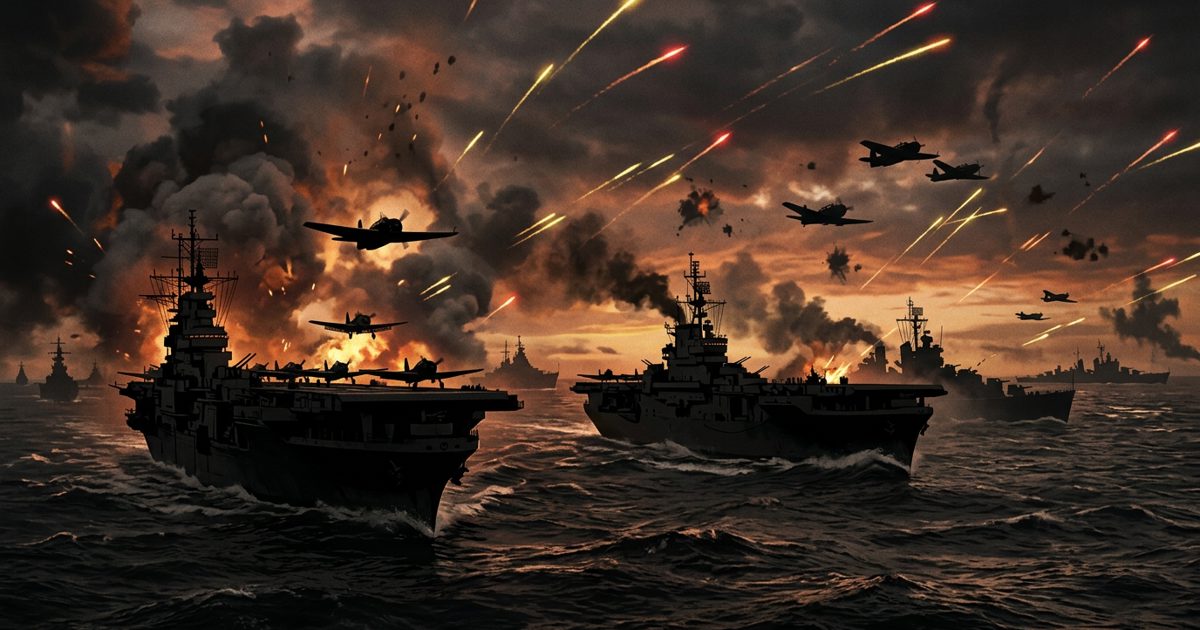
Kamikaze Attacks Sink Escort Carrier Bismarck Sea Off Iwo Jima

Japanese naval aviators launched a coordinated suicide strike against American naval forces supporting the amphibious invasion of Iwo Jima. Low cloud cover and fading evening light concealed the approaching formation of twin-engine bombers and fighters from radar operators until the planes flew within visual range. Fleet carrier USS Saratoga and escort carrier USS Bismarck Sea operated offshore to provide crucial combat air patrols and close air support for Marines storming the volcanic beaches. Six enemy planes targeted Saratoga in rapid succession, driving five direct hits and an aerial bomb into her flight deck and hull. The devastating impacts wrecked Saratoga's forward flight deck, ignited uncontrollable hangar fires, and killed 123 sailors before crewmen managed to contain the flames.

Smoke from the burning fleet carrier still billowed when additional suicide aircraft plunged toward the escort carrier USS Bismarck Sea. Antiaircraft gunners aboard Bismarck Sea opened fire with 40mm cannons, damaging incoming attackers. A Japanese plane crashed through the carrier's flight deck near the aft elevator, hurtling into the hangar deck and detonating among fully fueled aircraft. Torpedoes and high-explosive munitions exploded across the lower decks, cutting electrical power and disabling primary water mains needed to suppress the flames. A second kamikaze struck the elevator area moments later, destroying internal firefighting equipment and accelerating the raging fires.

Captain John L. Pratt ordered all surviving crew members to abandon ship as violent secondary explosions tore through the carrier's hull. Escorting destroyers and amphibious craft rushed through the darkening waters, pulling 605 survivors out of the sea under constant danger of further air attacks. Bismarck Sea rolled onto her starboard side and sank beneath the waves with the loss of 318 officers and enlisted sailors. The vessel became the final American aircraft carrier sunk by enemy action during World War II. Saratoga survived her severe damage but required immediate withdrawal to the Puget Sound Navy Yard for extensive reconstruction, ending her frontline combat service.

CHRONOLOGICAL RECORD

February 21 Across U.S. Military History

9 Verified Events
1862 U.S. Army Landmark Event • Civil War

Union and Confederate Troops Clash at Valverde Ford

Colonel Edward Canby led Union regulars and New Mexico volunteers against Brigadier General Henry Hopkins Sibley's Confederate brigade along the Rio Grande. Confederate forces launched a fierce charge that captured Captain Alexander McRae's federal artillery battery. Canby ordered his battered troops to withdraw into the adobe defenses of Fort Craig, leaving the Confederates in temporary possession of the battlefield.

1862 U.S. Navy • Civil War

David Farragut Takes Command of Blockading Squadron

Flag Officer David G. Farragut raised his pennant aboard the steam sloop USS Hartford at Ship Island, Mississippi. Farragut officially assumed command of the West Gulf Blockading Squadron with direct orders to breach Confederate river forts and capture New Orleans. His aggressive leadership transformed the squadron into an offensive assault force that broke Confederate control of the lower Mississippi River.

1943 Joint • World War II

Allied Amphibious Forces Secure the Russell Islands

Soldiers of the 43rd Infantry Division and Marine Raiders landed on Banika and Pavuvu during Operation Cleanslate. Allied reconnaissance units found that Japanese garrisons had already evacuated the island group under cover of darkness. Construction battalions immediately began building two forward airstrips to support subsequent assaults against Japanese bases in the central Solomon Islands.

1943 U.S. Coast Guard • Battle of the Atlantic

Cutter Campbell Battles U-Boats Shielding Convoy ON-166

Coast Guard Cutter Campbell engaged multiple German submarines that ambushed Allied merchant convoy ON-166 in the North Atlantic. Commander James Hirshfield directed depth charge attacks and gunfire that severely damaged submarine U-753 after dodging an incoming torpedo. Campbell rescued fifty merchant seamen from a torpedoed tanker and successfully protected the convoy's scattered rear flank through the night.

1944 U.S. Marine Corps Landmark Event • World War II

American Forces Secure Key Island of Eniwetok Atoll

Marines of the 22nd Marine Regiment and soldiers of the 106th Infantry Regiment overpowered Japanese defenders across Eniwetok Island in the Marshall Islands. Intense close-quarters fighting eliminated heavily concealed bunker positions and spider holes across both ends of the island. Securing Eniwetok Island cleared the way for the assault on nearby Parry Island and gave the fleet a vital anchorage.

1951 U.S. Army Landmark Event • Korean War

Eighth Army Launches Massive Counteroffensive Operation Killer

Lieutenant General Matthew B. Ridgway initiated Operation Killer to destroy Chinese Communist and North Korean forces south of the Han River. Eight United Nations divisions advanced methodically behind heavy artillery barrages and close air support. The coordinated offensive reclaimed critical ground and eliminated enemy forward concentrations across central Korea.

1968 U.S. Army • Vietnam War

Staff Sergeant Clifford Sims Sacrifices Life Near Hue

Staff Sergeant Clifford Chester Sims of the 101st Airborne Division led his squad into a heavily fortified bunker complex outside Hue. Sims heard the fuse of a concealed booby trap trigger and immediately threw his body directly onto the explosive device. His selfless action absorbed the full blast, saving his squad and earning the Medal of Honor.

1991 U.S. Marine Corps Landmark Event • Gulf War

Marine Harriers Launch Combat Strikes From USS Nassau

Marine Attack Squadron 331 launched AV-8B Harrier II jump jets from the flight deck of USS Nassau into Kuwait. Pilots conducted bombing missions against entrenched Iraqi troop positions, marking the first combat strikes ever flown by Harriers from an amphibious assault ship. The deployment proved the feasibility of using amphibious assault decks as forward jump-jet platforms.

2001 U.S. Air Force • Modern Era

Predator Drone Destroys Target Tank With Hellfire Missile

Air Force technicians successfully launched an AGM-114 Hellfire laser-guided missile from an RQ-1 Predator drone over the Nellis Air Force Base test range. The missile scored a direct hit, obliterating a stationary target tank. This successful live-fire test proved that unmanned aerial surveillance platforms could effectively deliver precision ordnance against armored ground targets.

WEAPONS AND TECHNOLOGY 2008

Operation Burnt Frost Destroys Rogue Satellite in Orbit

Sailors aboard the Aegis guided missile cruiser USS Lake Erie tracked a decaying reconnaissance satellite hurtling through low Earth orbit over the northern Pacific Ocean. Military commanders had designated the operation as Burnt Frost to eliminate the defunct National Reconnaissance Office satellite USA-193 before its toxic fuel tank could survive atmospheric reentry. Weapons officers loaded a specially modified RIM-161 Standard Missile-3 Block IA into the ship's vertical launch system. The Commander of U.S. Strategic Command authorized the strike as the target reached an orbital altitude of 247 kilometers.

Lake Erie launched the interceptor missile directly into the satellite's orbital trajectory with a closing velocity exceeding 22,000 miles per hour. Kinetic energy from the missile's exo-atmospheric kill vehicle obliterated the target upon impact, shattering the hazardous hydrazine tank and preventing environmental contamination on the ground. Sensor arrays aboard tracking ships and ground stations confirmed total destruction within minutes of the engagement. The successful intercept marked the first time the United States military destroyed a malfunctioning satellite using a sea-based ballistic missile defense system.