Operation Argument Launches the Allied Big Week Air Campaign
Over one thousand American heavy bombers struck German aircraft plants on February 20, 1944 to break the Luftwaffe.
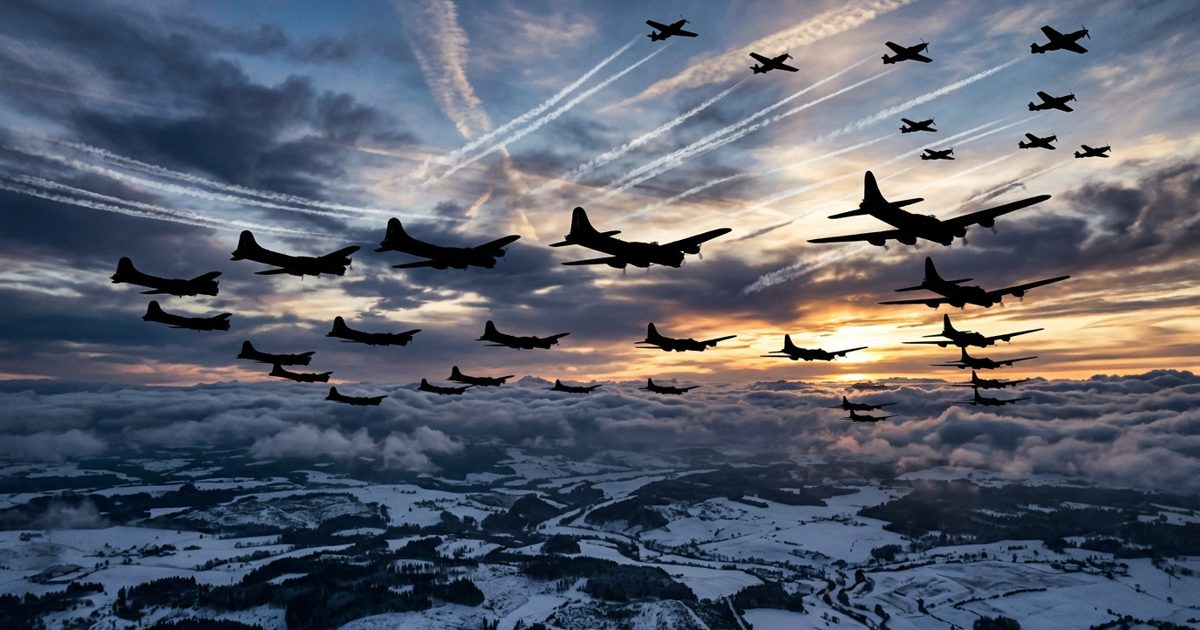
Operation Argument commenced on the morning of February 20, 1944, when the U.S. Eighth Air Force dispatched more than one thousand B-17 Flying Fortresses and B-24 Liberators from bases across eastern England. Lieutenant General Jimmy Doolittle directed the massive bomber formations toward German aircraft manufacturing centers at Leipzig, Brunswick, Tutow, and Bernburg. Allied high command sought to systematically destroy the Third Reich's fighter production factories while baiting the German Luftwaffe into a decisive battle of aerial attrition. Heavy cloud cover hindered visibility over northern routes, but the primary strike wings pressed deep into central Germany behind fighter screens.
Fighter escorts comprising Republic P-47 Thunderbolts and new long-range North American P-51 Mustangs aggressively ranged miles ahead of the bomber streams to intercept defending interceptors. Doolittle had recently rewritten escort doctrine, freeing American fighter pilots from close-formation tethering so they could hunt German aircraft across open airspace. German fighter wings scrambled Messerschmitt Bf 109s, Focke-Wulf Fw 190s, and twin-engine rocket-firing destroyers to halt the assault on their industrial hubs. Fierce dogfights erupted along the ingress corridors, resulting in heavy losses among the Luftwaffe's most seasoned pilots while allowing the bulk of American bombers to reach their designated release points.
Bombardiers released 2,218 tons of high explosives and incendiary ordnance over twelve primary production facilities, heavily damaging airframe assembly lines and ball-bearing complexes. Eighth Air Force lost twenty-one heavy bombers and four fighters during the initial day of raids, a fraction of the losses Allied planners had initially feared. Royal Air Force Bomber Command continued the offensive that night by sending over eight hundred aircraft against Leipzig. The opening strikes of Big Week ultimately deprived the German aviation industry of two months of production capacity and inflicted fatal attrition on the Luftwaffe's frontline interceptor strength ahead of the Normandy invasion.