Full Calendar
THIS DAY IN U.S. MILITARY HISTORY • JANUARY 3 1777 Continental Army American Revolutionary War

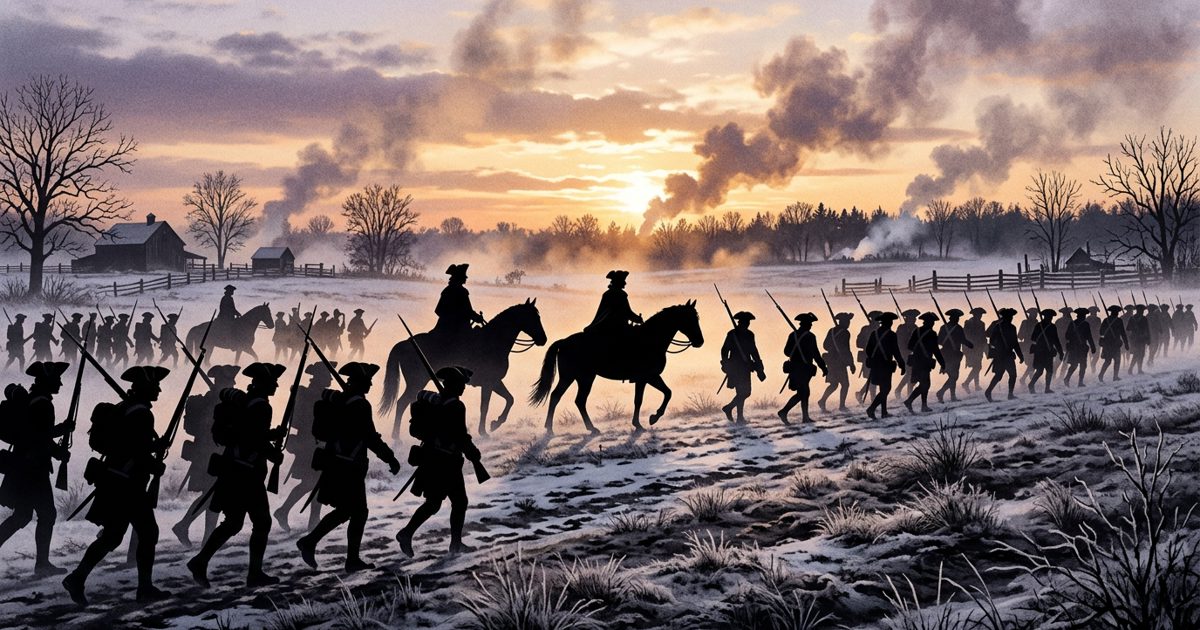
General Washington Strikes British Regiments at Princeton

Continental Army brigades execute an overnight flank march around Cornwallis to shatter enemy regulars on the Clarke farm outside Princeton.
General Washington Strikes British Regiments at Princeton

General George Washington withdrew his army from Trenton under cover of darkness to strike the isolated British garrison at Princeton. Continental campfires burned along Assunpink Creek to deceive General Lord Cornwallis while five thousand American soldiers muffled their artillery carriage wheels with rags and marched northeast along icy back roads. Brigadier General Hugh Mercer led the advance guard across stony ground near Stony Brook just after sunrise and collided with British Lieutenant Colonel Charles Mawhood commanding the 17th Regiment of Foot. British soldiers leveled their muskets, delivered two disciplined volleys into the orchard of William Clarke, and launched a bayonet charge that mortally wounded Mercer and shattered his vanguard.

Washington arrived on his white horse to rally retreating militiamen and reestablish the American line. Continental officers brought forward Colonel John Cadwalader's Philadelphia Associators and deployed Captain Joseph Moulder's battery of two field guns on the high ground near Thomas Clarke's house. British regulars pressed their attack until Washington rode within thirty yards of the enemy line, shouted commands to hold formation, and ordered his infantry to fire. Smoke engulfed the field as both sides discharged simultaneous volleys, leaving Washington unharmed and Mawhood's infantry reeling from devastating grapeshot and musket fire.

American infantry charged forward with fixed bayonets and broke the remaining British formations across the farm fields. Lieutenant Colonel Mawhood ordered a desperate retreat south toward Trenton while fleeing elements of the 55th Foot and 40th Foot took refuge inside the stone walls of Nassau Hall at the College of New Jersey. Captain Alexander Hamilton directed Continental artillery fire into the college building, prompting nearly two hundred British soldiers to display white flags and surrender. Washington marched his victorious forces north to secure winter quarters in the hills around Morristown, compelling the British army to abandon its outposts across central and southern New Jersey.

CHRONOLOGICAL RECORD

January 3 Across U.S. Military History

8 Verified Events
1861 U.S. Army • Civil War Era

Georgia State Militia Seizes Unoccupied Fort Pulaski

Georgia volunteer militia companies boarded steamers in Savannah and seized Fort Pulaski on Cockspur Island without bloodshed. Governor Joseph E. Brown ordered the takeover to secure coastal approaches before the state formally seceded from the Union. Confederate forces subsequently garrisoned the brick fortification until Federal rifled artillery breached its walls in April 1862.

1944 U.S. Navy • World War II

Destroyer USS Turner Sinks Off New York Harbor

Explosions tore through the ammunition magazines of the Gleaves-class destroyer USS Turner while anchored off Sandy Hook, New Jersey. Fire and secondary detonations sank the warship within two hours, killing 136 crewmen. Coast Guard and Navy vessels rescued 163 survivors, prompting the first operational helicopter flight to deliver emergency blood plasma to treating physicians.

1945 U.S. Army Landmark Event • World War II

First Army Launches Ardennes Salient Counteroffensive

Infantry divisions from Lieutenant General Courtney Hodges's U.S. First Army attacked south through heavy snow toward Houffalize, Belgium. Reinforced by British armor, American troops engaged German panzer units holding the northern shoulder of the Ardennes salient. Third Army launched parallel thrusts from the south, initiating the coordinated pincer drive that eliminated the German Bulge.

1945 U.S. Marine Corps • World War II

Marine Aviators Fly Historic Carrier Strikes on Formosa

Corsair fighters from Marine squadrons VMF-124 and VMF-213 launched from the aircraft carrier USS Essex to strike Japanese airfields on Formosa. Pilots destroyed enemy aircraft on the ground and shot down interceptors during sweeps supporting the upcoming Lingayen Gulf invasion. Missions flown that morning marked the first combat strikes conducted by carrier-based Marine Corps aviation units.

1961 U.S. Army • Cold War

Stationary Nuclear Reactor Explodes at Idaho Testing Station

Technicians performing maintenance on the U.S. Army SL-1 prototype nuclear reactor triggered an unintended prompt-critical reaction when a control rod was manually withdrawn. The resulting steam explosion destroyed the reactor vessel at the National Reactor Testing Station in Idaho, killing three military specialists instantly. Investigations led to comprehensive overhauls of military and civilian reactor safety mechanisms.

1984 U.S. Navy • Cold War

Syrian Authorities Release Captured Navy Aviator Robert Goodman

President Hafez al-Assad approved the release of Navy Lieutenant Robert O. Goodman in Damascus following negotiations conducted by civil rights leader Jesse Jackson. Syrian air defense forces had shot down Goodman's A-6E Intruder over Lebanon on December 4, 1983, killing pilot Lieutenant Mark Lange. American authorities welcomed the repatriated flight officer home at Andrews Air Force Base.

1990 Joint Service Landmark Event • Post-Cold War

Dictator Manuel Noriega Surrenders in Panama City

General Manuel Noriega walked out of the Papal Nunciature in Panama City and surrendered to waiting U.S. Army special operations personnel. American forces had surrounded the diplomatic mission for ten days during Operation Just Cause using psychological operations broadcasts to compel his capitulation. Soldiers escorted Noriega aboard a military transport aircraft for extradition and trial in Miami.

2020 U.S. Air Force Landmark Event • War on Terror

American Drone Strike Eliminates Qasem Soleimani in Baghdad

Missiles launched by a U.S. Air Force MQ-9 Reaper drone struck a two-vehicle convoy departing Baghdad International Airport. The precision strike eliminated Iranian Major General Qasem Soleimani, commander of the Islamic Revolutionary Guard Corps Quds Force, alongside Iraqi militia chief Abu Mahdi al-Muhandis. American defense leaders executed the operation to disrupt planned attacks against allied diplomatic and military personnel.

MEDAL OF HONOR ACTION 1944

Major Gregory Boyington Scores His Final Victories Over Rabaul

Major Gregory Boyington led forty-eight Allied fighters on an aggressive sweep over Lakunai airfield at Rabaul, New Britain. Marine Fighting Squadron 214, known as the Black Sheep, flew their F4U-1 Corsair fighters at twenty thousand feet to draw Japanese interceptors into combat. Imperial Japanese Navy pilots scrambled dozens of A6M Zero fighters to challenge the American formation above Saint George's Channel. Boyington engaged the enemy aircraft in a swirling dogfight, shooting down his twenty-sixth confirmed kill to equal the American fighter ace record established during World War I and the Guadalcanal campaign.

Japanese fighters swarmed Boyington's Corsair from high altitude after his wingman, Captain George Ashmun, took heavy damage and plunged toward the water. Enemy cannon shells pierced the fuel tank of Boyington's aircraft, igniting a cockpit fire and forcing him to bail out at low altitude over the ocean. Crewmen from a Japanese submarine captured the wounded squadron commander several hours later and transferred him to a clandestine prisoner-of-war camp near Tokyo for the remainder of the war. President Harry S. Truman presented Boyington with the Medal of Honor in October 1945 for his extraordinary aerial combat leadership throughout the Solomons campaign culminating in the final January 3, 1944 mission.