Full Calendar
THIS DAY IN U.S. MILITARY HISTORY • JANUARY 31 1944 Joint Service World War II

Operation Flintlock Storms Kwajalein Atoll

Admiral Chester Nimitz launched the Fifth Fleet and V Amphibious Corps against Japanese bases in the Marshall Islands on January 31, 1944.
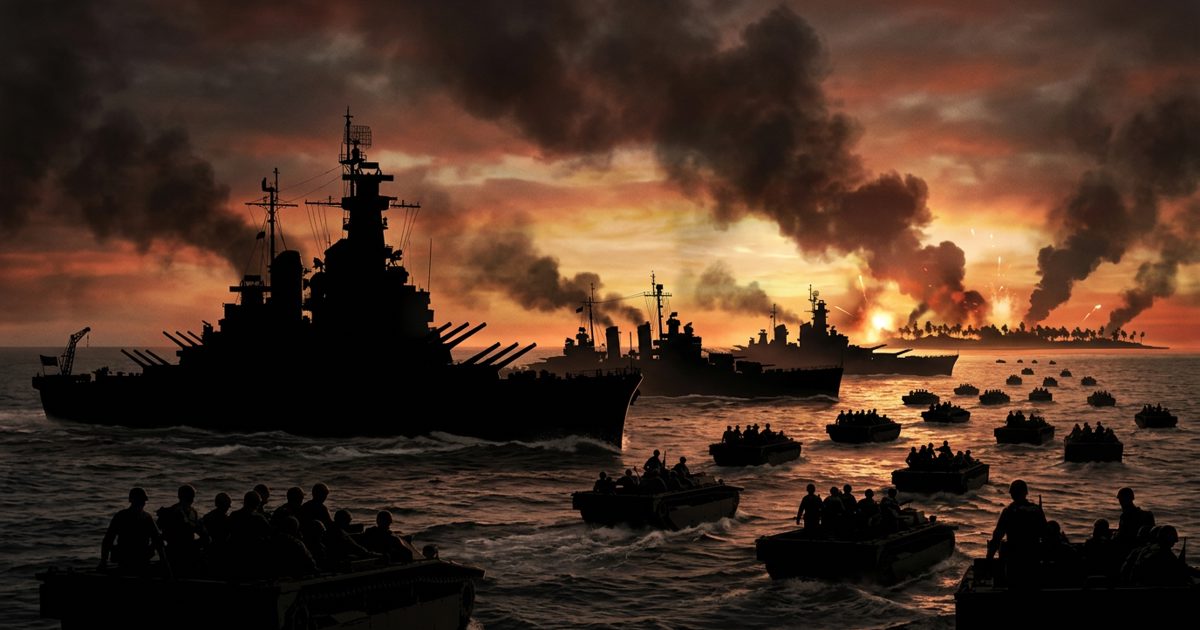
Operation Flintlock Storms Kwajalein Atoll

Battleships and cruisers of Vice Admiral Raymond Spruance's Fifth Fleet opened a massive naval bombardment against Japanese positions across Kwajalein Atoll at dawn on January 31, 1944. Naval gunners and carrier aircraft delivered sustained fire to destroy reinforced concrete bunkers, deliberately applying tactical lessons learned from the costly assault at Tarawa two months prior. Operation Flintlock marked the first Allied offensive directed against territory held by Imperial Japan before the outbreak of World War II. Specialized assault teams prepared to seize outlying islets first, aiming to emplace field artillery within direct range of the main island garrisons.

Soldiers of the Army's 7th Infantry Division launched dawn assaults in rubber boats and tracked amphibious vehicles to seize four islets flanking the southern passage into the lagoon. Cavalry reconnaissance troops rapidly overran entrenched Japanese outposts across the small islands, securing safe deep-water passage for fleet support vessels. Combat engineers hauled medium artillery pieces onto the captured coral beaches under sporadic enemy fire. These field gun batteries established overlapping fields of fire directly targeting the fortified Japanese airfield on Kwajalein Island.

Marines of the 4th Marine Division executed similar landings around Roi and Namur in the northern sector of the atoll, clearing five small islands by midday. Artillery crews from the 14th Marines brought pack howitzers ashore on the secured positions to bombard the primary Japanese runways and ammunition dumps. Navy underwater demolition teams surveyed the inner reef approaches, identifying natural channels and destroying submerged obstacles for upcoming landing waves. American joint forces controlled every designated perimeter objective by nightfall, preparing the final amphibious push that conquered the atoll one week later.

CHRONOLOGICAL RECORD

January 31 Across U.S. Military History

8 Verified Events
1863 U.S. Navy • American Civil War

Confederate Ironclads Raid the Charleston Blockade

Ironclads CSS Palmetto State and CSS Chicora slipped out of Charleston Harbor before dawn on January 31, 1863, attacking Union blockaders. Cannon fire and ramming crippled the steam gunboat USS Mercedita and damaged USS Keystone State. Federal warships withdrew temporarily into deeper water, but Union commanders reinforced the offshore blockade within hours.

1945 U.S. Army Landmark Event • World War II

Army Firing Squad Executes Private Eddie Slovik

Soldiers of the 109th Infantry Regiment executed Private Eddie Slovik by firing squad near Sainte-Marie-aux-Mines, France, on January 31, 1945. Court-martial judges convicted Slovik of desertion under fire after he repeatedly refused front-line rifle duty. General Dwight D. Eisenhower confirmed the death sentence, making Slovik the only American soldier executed for desertion since the Civil War.

1945 U.S. Army • World War II

Paratroopers Stage Amphibious Assault at Nasugbu

Troops from the 11th Airborne Division stormed ashore at Nasugbu Bay on southwestern Luzon on January 31, 1945. Glider infantrymen rapidly overwhelmed scattered Japanese defenders and captured key bridges along Highway 17 intact. Major General Joseph Swing exploited the beachhead to begin an overland dash toward Tagaytay Ridge, opening a southern route for the liberation of Manila.

1951 U.S. Army • Korean War

Borinqueneers Launch Assault South of Seoul

Infantrymen of the Puerto Rican 65th Infantry Regiment launched a coordinated assault against fortified positions south of Seoul on January 31, 1951. Operating under the 3rd Infantry Division during Operation Thunderbolt, the regiment fought through freezing temperatures to secure strategic hills overlooking the Han River. Their fierce multi-day attack culminated in an aggressive bayonet assault that forced enemy defenders to retreat.

1951 U.S. Air Force • Korean War

Troop Carrier Drops Agent Behind Lines

Aircrews of the 21st Troop Carrier Squadron conducted the Korean War's first documented covert agent drop behind enemy lines on January 31, 1951. Flying through darkness near Yonan, airmen parachuted a United Nations intelligence operative into hostile territory to gather tactical reports on enemy troop movements. The successful clandestine sortie established procedures for subsequent special air operations across North Korea.

1958 U.S. Army Landmark Event • Cold War

Army Ballistic Missile Agency Launches Explorer One

Engineers of the Army Ballistic Missile Agency launched Explorer 1 into Earth orbit from Cape Canaveral on January 31, 1958. Propelled by a modified Jupiter-C rocket, the thirty-pound satellite carried cosmic-ray detection instrumentation designed by physicist James Van Allen. The spacecraft confirmed the presence of radiation belts circling the planet, placing the United States into space exploration.

1968 Joint Service Landmark Event • Vietnam War

Viet Cong Sappers Breach American Embassy

Sappers of the Viet Cong C-10 Sapper Battalion dynamited the exterior wall of the United States Embassy in Saigon early on January 31, 1968. Marine Security Guards and Army military police immediately traded gunfire with the infiltrators across the compound gardens. American defenders killed or captured all nineteen attackers before they could breach the main chancery building.

1968 U.S. Marine Corps Landmark Event • Vietnam War

Marines Relieve Besieged MACV Compound at Hue

Marines from Task Force X-Ray pushed through intense sniper and rocket fire along Highway 1 on January 31, 1968, to reinforce the besieged military compound at Hue. Two undermanned Marine companies fought through urban ambushes to link up with encircled American and allied advisers. Their arrival anchored the southern perimeter, marking the opening day of the bitter month-long Battle of Hue.

MEDAL OF HONOR ACTION 1943

Marine Pilot Jefferson DeBlanc Downs Five Enemy Fighters Over Kolombangara

Lieutenant Jefferson Joseph DeBlanc led six Marine F4F Wildcat fighters escorting American dive bombers over Kolombangara Island on January 31, 1943. Japanese Mitsubishi A6M Zeros attacked the formation at high altitude, drawing the escort into violent dogfights. DeBlanc spotted enemy floatplanes swooping down to strike the vulnerable dive bombers below. Diving into the hostile formation, he blasted two enemy aircraft out of the sky and dispersed the attack, allowing the bombers to complete their strikes.

DeBlanc reengaged the surviving Japanese fighter screen despite noticing a critically low fuel reading on his instrument panel. Enemy interceptors surrounded his Wildcat, but he turned into the attackers and destroyed three additional fighters in rapid succession. Hostile cannon fire ignited his engine, forcing him to parachute into the waters of Vella Gulf. Local islanders sheltered the wounded aviator until a Navy flying boat rescued him two weeks later, securing his survival after shooting down five aircraft in a single flight.