Full Calendar
THIS DAY IN U.S. MILITARY HISTORY • MARCH 13 1944 U.S. Army World War II

Soldiers of the 37th Infantry Division Secure Hill 700 on Bougainville

Ohio National Guard infantrymen crush a fierce Japanese counteroffensive overlooking Cape Torokina in brutal jungle combat.
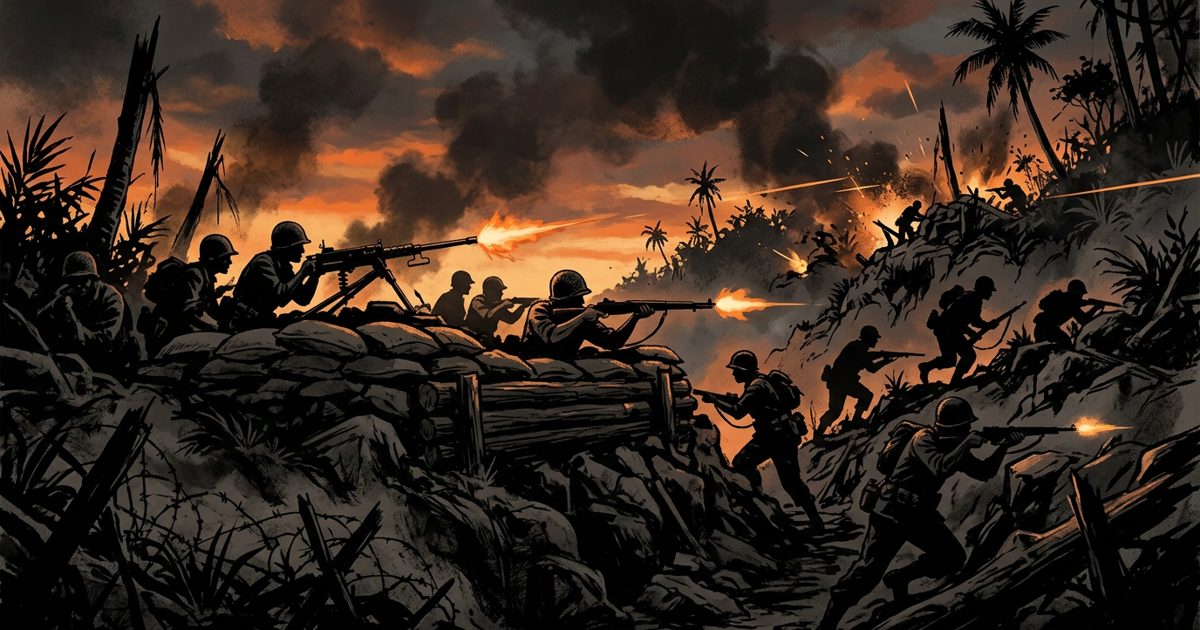
Soldiers of the 37th Infantry Division Secure Hill 700 on Bougainville

Soldiers of the 37th Infantry Division, composed largely of Ohio National Guardsmen under Major General Robert S. Beightler, repelled the final assault of the Japanese 6th Division on Hill 700. Lieutenant General Masatane Hyakutake had committed over four thousand troops from the 13th and 23rd Infantry Regiments to seize the elevation, aiming to rain artillery fire onto the Allied bomber strips at Cape Torokina. Combat exploded when enemy infiltration teams blasted through defensive barbed wire with bangalore torpedoes and captured several forward pillboxes along the crest. Japanese gunners dragged mountain howitzers up the jungle slopes to support their breakthrough, but American machine gunners and mortar crews prevented any wider exploitation.

Reinforcements from the 2nd Battalion, 148th Infantry Regiment moved up the muddy ridgeline to assist the exhausted men of the 145th Infantry. Lieutenant Colonel Herb Radcliffe directed his companies into counterattack formations amid continuous sniper and mortar fire. American riflemen advanced behind creeping artillery barrages and naval gunfire provided by destroyers offshore, clearing Japanese positions with flamethrowers, satchel charges, and point-blank rifle volleys. Heavy hand-to-hand fighting erupted in the dense jungle ravines as American squads retook every lost bunker.

Combat on the ridge ceased as surviving Japanese units withdrew into the island interior, leaving behind more than three hundred dead across the scarred crest. Allied command tallied minimal American losses while securing the entire perimeter around Empress Augusta Bay. The victory permanently eliminated the surface threat to the Piva airfields and allowed Allied aircraft to maintain uninterrupted air supremacy over Rabaul. Engineers quickly reinforced the perimeter bunkers, while forward reconnaissance units pushed patrols into the foothills to prevent any reorganization of enemy lines.

CHRONOLOGICAL RECORD

March 13 Across U.S. Military History

8 Verified Events
1776 Continental Navy • American Revolutionary War

Continental Congress Directs Purchase of Brig Lexington

Delegates voted to acquire the merchant brigantine Wild Duck in Philadelphia for service in the Continental Navy. The vessel was renamed Lexington and placed under the command of Captain John Barry. Barry soon took the ship down the Delaware River to protect colonial shipping and engage British warships.

1862 U.S. Army Landmark Event • Civil War

Congress Prohibits Return of Escaped Slaves

Lawmakers approved a new Article of War forbidding Union military officers from returning escaped enslaved individuals to Confederate owners under penalty of court-martial. President Abraham Lincoln signed the statute into law the same day. This measure dismantled military enforcement of the Fugitive Slave Act of 1850 and protected refugees entering Union lines.

1862 U.S. Army • Civil War

Union Forces Compel Evacuation of New Madrid

Soldiers under Union Major General John Pope besieged Confederate fortifications at New Madrid, Missouri, compelling the enemy garrison to evacuate under cover of a heavy storm. Naval gunboats and shore artillery battered Confederate positions throughout the daylight hours. Rebel troops abandoned thirty-three heavy cannons and stockpiles of munitions as they retreated across the Mississippi River.

1942 U.S. Army Landmark Event • World War II

War Department Activates the K-9 Corps

Robert P. Patterson, the Under Secretary of War, authorized the Quartermaster Corps to establish the military War Dog Program, officially creating the Army K-9 Corps. Civilian volunteers from Dogs for Defense mobilized dog owners across the nation to donate animals for sentry and patrol duties. Military working dogs served in every theater of World War II, establishing March 13 as national K-9 Veterans Day.

1942 U.S. Army Landmark Event • World War II

Julia O Flikke Becomes First Female Colonel

Julia O. Flikke, superintendent of the Army Nurse Corps, received promotion to the relative rank of Colonel, becoming the first woman to achieve that rank in the United States Armed Forces. Her assistant superintendent Florence A. Blanchfield was promoted to lieutenant colonel during the same ceremony. Flikke oversaw the massive mobilization and deployment of thousands of military nurses to overseas battlefields throughout World War II.

1944 U.S. Navy • World War II

Hunter-Killer Group 21 Sinks Submarine U-575

Aircraft and warships assigned to Task Group 21.11, centered on the escort carrier USS Bogue, coordinated to sink the German submarine U-575 north of the Azores. A VC-95 Avenger bomber attacked the U-boat alongside Canadian frigate HMCS Prince Rupert, British bombers, and destroyers USS Hobson and USS Haverfield. Sustained depth charge attacks and naval gunfire breached the submarine hull, forcing forty-three survivors to surrender.

1956 U.S. Navy • Cold War

Attack Squadron 83 Deploys First Carrier Missiles

Aviators of Attack Squadron 83 deployed aboard the aircraft carrier USS Intrepid, making the squadron the first in Navy history to take guided missiles to sea on an operational cruise. The squadron flew Chance Vought F7U-3M Cutlass jet fighters equipped with AIM-7 Sparrow air-to-air missiles. This deployment introduced missile technology directly into carrier strike group air defense operations.

1997 U.S. Marine Corps • Modern Era

Operation Silver Wake Evacuates Civilians From Albania

Marines of the 26th Marine Expeditionary Unit launched Operation Silver Wake from the USS Nassau Amphibious Ready Group into Tirana, Albania. Heavy civil unrest had erupted following the collapse of nationwide financial schemes, leaving the American embassy surrounded by armed chaos. Marine CH-53E Super Stallion helicopters extracted 877 Americans and foreign nationals over five days of continuous airlift flights.

MEDAL OF HONOR ACTION 1945

Technical Sergeant Morris E Crain Holds the Line at Haguenau

Morris E. Crain led his rifle platoon from Company E, 141st Infantry Regiment, 36th Infantry Division, during combat to expand a bridgehead across the Moder River in Haguenau, France. German infantry supported by armor counterattacked, raking the sector with artillery and tank gunfire. Crain spearheaded his platoon, killing ten enemy soldiers and capturing twelve prisoners while securing an important road junction. Enemy pressure increased as German tanks moved into point-blank range, blasting defensive positions and forcing squads to withdraw house by house.

Crain dashed through heavy fire to the foremost house where five soldiers remained pinned down by advancing armor. Seeing a tank firing directly into the walls and enemy infantry bursting inside, he ordered his men to withdraw while he stayed behind alone. The sergeant engaged the attackers with his submachine gun, killing three enemy soldiers and halting the assault. German shells destroyed the house over his position, killing him instantly and earning him a posthumous Medal of Honor.