Full Calendar
THIS DAY IN U.S. MILITARY HISTORY • MARCH 20 1922 U.S. Navy Interwar Period

Navy Commissions USS Langley as First American Aircraft Carrier

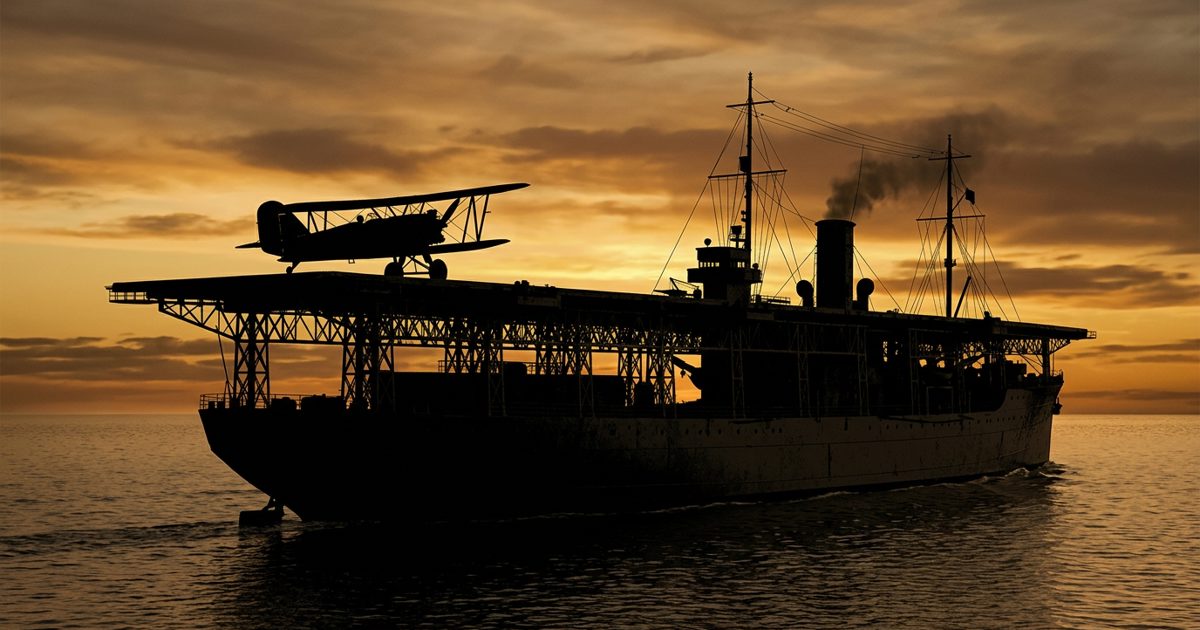
Naval engineers convert a bulk coal carrier at Norfolk into the sea service primary experimental flight deck in 1922.
Navy Commissions USS Langley as First American Aircraft Carrier

Shipbuilders at the Norfolk Navy Yard in Virginia transferred custody of the newly converted USS Langley to naval officers, formally placing the vessel in commission. Workers had spent two years transforming the 1913 coal carrier USS Jupiter into an operational floating aerodrome designated CV-1. Naval constructors erected a 533-foot wooden flight deck over the open cargo holds, supported by a web of steel lattice girders that gave the vessel its nickname of the Covered Wagon. Commander Kenneth Whiting assumed temporary command during the ceremony, taking charge of a platform designed to resolve unanswered questions about naval aviation doctrine.

Whiting immediately organized test programs to prove whether conventional wheeled aircraft could operate reliably from moving warships. Engineers installed an experimental compressed-air catapult, two elevators, and an intricate arresting gear mechanism utilizing weights and longitudinal wires to trap landing planes. Naval aviators conducted preliminary flights from simulated decks ashore before transferring squadrons of Vought VE-7 fighters and Aeromarine spotters to the ship. Langley operated as a floating laboratory, providing naval architects with crucial mechanical data regarding wind turbulence, deck handling, and hangar space constraints.

Flight deck operations developed aboard the ship formed the operational blueprint for the subsequent carriers Lexington and Saratoga. Deck crews perfected rapid launch cycles, barrier nets, and rolling landing procedures that allowed aircraft to integrate directly into fleet battle problems throughout the 1920s. Bureau officials eventually reclassified the aging hull as a seaplane tender in 1937 after larger purpose-built carriers entered fleet service. Langley remained on active duty until enemy air attacks forced escorts to scuttle the vessel off Java in February 1942.

CHRONOLOGICAL RECORD

March 20 Across U.S. Military History

9 Verified Events
1833 U.S. Navy Landmark Event • Early Republic

Sloop Peacock Concludes Historic Treaty with Siam

Diplomat Edmund Roberts and Master Commandant David Geisinger signed the Treaty of Amity and Commerce with Siamese officials in Bangkok aboard the sloop of war USS Peacock. The agreement established formal trade regulations and consular access, creating the first bilateral treaty between the United States and an Asian monarchy.

1865 U.S. Army • Civil War

Union Wings Converge at the Battle of Bentonville

Major General Oliver O. Howard led the Union Army of the Tennessee into position on the field near Bentonville, North Carolina. Howard linked his corps with Major General Henry Slocum's battered left wing, confronting General Joseph E. Johnston's Confederate line. The deployment forced Confederate defenders into a defensive horseshoe anchored on Mill Creek.

1918 U.S. Army • World War I

Army Air Service Redesignates Alessandro Field as March Field

War Department officials redesignated Alessandro Flying Training Field in Riverside County, California, as March Field. The installation honored Second Lieutenant Peyton C. March Jr., an aviator killed in a Texas training crash. The facility soon expanded into a permanent aviation hub, serving as March Air Force Base throughout subsequent global conflicts.

1942 U.S. Army Landmark Event • World War II

General Douglas MacArthur Pledges Return to the Philippines

General Douglas MacArthur addressed reporters at the rural railway depot in Terowie, South Australia, following his evacuation from Corregidor. MacArthur publicly declared that he had broken through Japanese lines and would return to liberate American and Filipino troops. The statement became the defining strategic pledge of Allied operations across the Pacific theater.

1944 U.S. Marine Corps • World War II

Marines Secure Emirau Island in Operation Foretop

Marines from the reconstituted 4th Marine Regiment landed on Emirau Island in the Bismarck Archipelago without meeting Japanese resistance. Navy construction battalions immediately began building heavy bomber strips and harbor installations on the coral atoll. The landing completed the Allied encirclement of Rabaul, neutralizing over one hundred thousand Japanese garrison troops.

1945 U.S. Navy • World War II

Destroyer Halsey Powell Survives Kamikaze Attack off Kyushu

Japanese aircraft attacked Task Force 58 warships operating off Kyushu while American carriers struck mainland Japanese airfields. A suicide plane crashed alongside the destroyer USS Halsey Powell as it cast off from refueling next to USS Hancock. The impact killed nine sailors and damaged steering gear, but the destroyer maintained formation under auxiliary control.

1952 Joint Landmark Event • Cold War

Senate Ratifies United States and Japan Security Treaty

Senators voted 58 to 9 to ratify the Security Treaty Between the United States and Japan. The bilateral pact authorized American military forces to maintain garrisons, air stations, and naval facilities across Japanese territory after the end of the post-war occupation. The treaty formed the bedrock of American forward military posture in East Asia.

1969 U.S. Army • Vietnam War

Corporal Terry Kawamura Sacrifices Life at Camp Radcliff

Corporal Terry Teruo Kawamura of the 173rd Engineer Company leaped onto a satchel charge thrown through a roof by enemy sappers infiltrating Camp Radcliff. His action absorbed the blast and saved two fellow soldiers inside the room. Kawamura was posthumously awarded the Medal of Honor for his selfless gallantry during the assault.

2003 Joint Landmark Event • Iraq War

Coalition Forces Launch Operation Iraqi Freedom Assaults

Coalition forces commenced combat operations in Iraq with precision cruise missile strikes on leadership compounds in Baghdad and artillery preparatory fires along the Kuwaiti border. Elements of the 3rd Infantry Division and the 1st Marine Expeditionary Force surged across the berm into southern Iraq. The combined air and ground offensive began twenty-one days of maneuvering toward Baghdad.

MEDAL OF HONOR ACTION 1967

Specialist Charles Hagemeister Bravery in Binh Dinh Province

Specialist Fourth Class Charles Chris Hagemeister moved with a platoon from the 1st Battalion, 5th Cavalry, 1st Cavalry Division into the village of Tan An in Binh Dinh Province. North Vietnamese Army soldiers opened concentrated fire from concealed bunkers on three sides, immediately pinning down the point elements and inflicting severe casualties. Hagemeister heard the cries of wounded soldiers and sprinted through machine-gun fire across open terrain to administer emergency medical aid. Hostile rounds struck the dirt around his position as he treated the wounded platoon leader and shielded other casualties with his own body.

Enemy riflemen attempted to encircle the casualties, bringing Hagemeister under direct sniper fire at point-blank range. Hagemeister picked up a rifle from a fallen infantryman, eliminated the sniper, killed three approaching enemy soldiers, and silenced an adjacent machine-gun position. The medic then ran through heavy fire to summon reinforcements from a sister platoon and guided them back to extract the casualties. President Lyndon B. Johnson presented the Medal of Honor to Hagemeister at the White House on May 14, 1968.