Full Calendar
THIS DAY IN U.S. MILITARY HISTORY • MARCH 26 1943 U.S. Navy World War II

American Warships Fight Daylight Surface Duel at Komandorski Islands

Rear Admiral Charles McMorris leads outgunned American cruisers and destroyers against a superior Japanese naval force in the freezing waters of the Bering Sea.
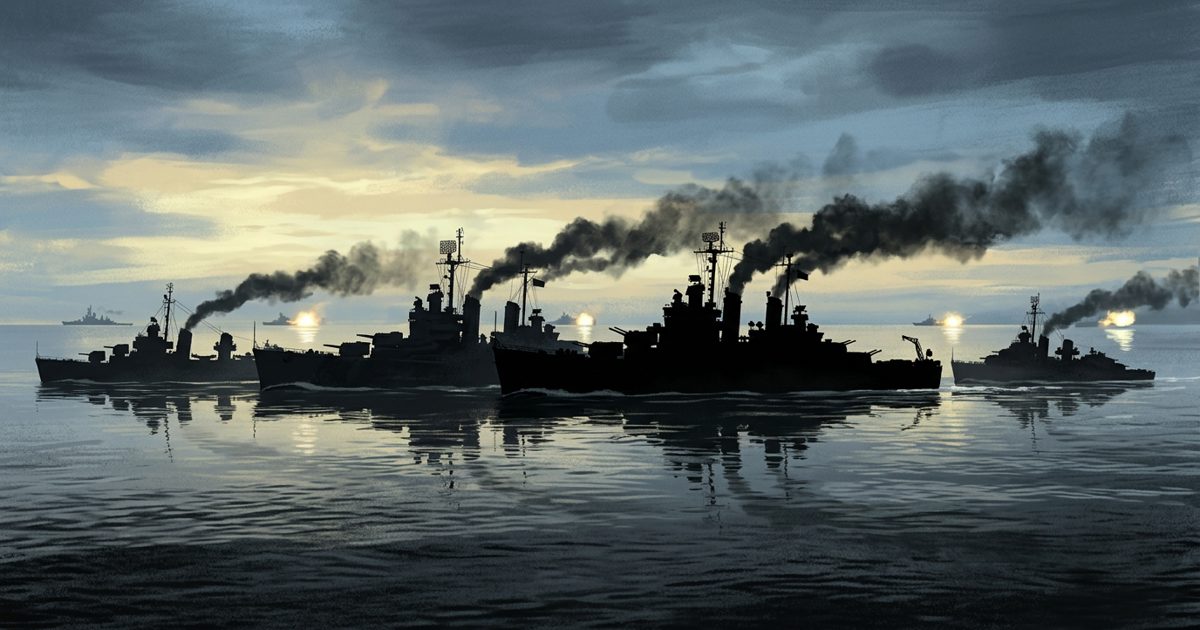
American Warships Fight Daylight Surface Duel at Komandorski Islands

3p3Task Group 16.6 patrolled the icy waters south of the Soviet Komandorski Islands to block Japanese convoys bound for occupied Attu and Kiska. Rear Admiral Charles McMorris commanded the American force from his flagship light cruiser USS Richmond, accompanied by the heavy cruiser USS Salt Lake City and four destroyers. Lookouts sighted a Japanese convoy escorted by Vice Admiral Boshiro Hosogaya, whose fleet possessed two heavy cruisers, two light cruisers, and four destroyers. Hosogaya held twice the heavy naval rifle power of McMorris, but the American commander chose to attack rather than retreat. Long-range naval gunfire erupted across calm Arctic seas at ranges exceeding twenty thousand yards.3/p33p3Japanese gunners focused their eight-inch batteries on Salt Lake City, scoring hits that flooded compartments and extinguished boiler fires. Boiler technicians fought rising seawater as the heavy cruiser drifted to a dead stop with contaminated fuel lines. Destroyers USS Bailey, USS Coghlan, and USS Monaghan charged into enemy fire to shield the immobile cruiser behind thick white smokescreens. Commander John Atkeson turned Bailey directly toward the Japanese cruisers to launch a daylight torpedo attack, drawing heavy fire away from Salt Lake City.3/p33p3Admiral Hosogaya observed the charging destroyers and mistakenly deduced that American air support had arrived. Dwindling ammunition and the fear of aerial strikes convinced the Japanese commander to break off pursuit and order a retreat toward Paramushiro. Technicians aboard Salt Lake City purged the fuel lines, reignited the boilers, and restored propulsion before enemy ships vanished over the horizon. Task Group 16.6 escorted the damaged cruiser home to Dutch Harbor. Japanese commanders never dispatched another surface convoy to reinforce the Aleutian garrisons, relying entirely on submarines for the remainder of the campaign.3/p3

CHRONOLOGICAL RECORD

March 26 Across U.S. Military History

9 Verified Events
1777 Continental Navy • American Revolutionary War

Continental Congress Suspends Commodore Esek Hopkins

Delegates voted to suspend Commodore Esek Hopkins from his position as commander in chief of the Continental Navy. Lawmakers acted after subordinate officers submitted formal complaints regarding his conduct and mistreatment of prisoners. His suspension concluded with formal dismissal from naval service ten months later.

1862 U.S. Army Landmark Event • Civil War

Union Troops Turn Back Confederates at Apache Canyon

Major John Chivington led Union infantrymen and cavalry against Confederate troops under Major Charles Pyron at Apache Canyon in New Mexico Territory. Union skirmishers scaled canyon walls to flank the Texan artillery, forcing the Confederates to retreat toward Johnson Ranch. The engagement opened three days of combat at Glorieta Pass that halted Confederate expansion into the American West.

1942 U.S. Army Air Forces • World War II

Douglas C-54 Skymaster Transport Makes Maiden Flight

Pilots flew the prototype Douglas C-54 Skymaster military transport for the first time from Clover Field in Santa Monica, California. Douglas Aircraft engineers adapted the airliner design to satisfy wartime cargo requirements by installing reinforced flooring and an interior hoist. The four-engine transport subsequently flew vital supply routes over the Himalayan Hump and sustained the Berlin Airlift.

1945 U.S. Marine Corps Landmark Event • World War II

Marine Commanders Officially Secure Island of Iwo Jima

Major General Harry Schmidt declared combat operations completed on Iwo Jima after Marines eliminated a desperate final counterattack by Japanese troops. Fifth Amphibious Corps forces ended five weeks of vicious combat that cost nearly seven thousand American lives. The captured airstrips immediately provided emergency landing grounds and fighter escorts for Boeing B-29 bombers attacking the Japanese homeland.

1945 U.S. Army • World War II

Seventy-Seventh Infantry Division Lands on Kerama Retto

Soldiers from the 77th Infantry Division launched amphibious assaults across six islands of the Kerama Retto chain west of Okinawa. Troops overwhelmed local defenders and captured approximately 350 explosive-laden Japanese suicide boats hidden inside shoreline caves. Seizing the island cluster provided the United States Fifth Fleet with an anchorage for forward logistics and vessel repairs.

1949 U.S. Air Force • Cold War

Prototype Convair YB-36D Peacemaker Bomber Takes Flight

Crews conducted the maiden flight of the prototype Convair YB-36D heavy bomber from Fort Worth, Texas. Manufacturers modified the colossal aircraft by pairing four General Electric J47 turbojets with its six existing piston radial engines. This mixed-propulsion configuration delivered the auxiliary thrust required for heavy payload takeoffs and high-speed dashes toward targets.

1953 U.S. Marine Corps • Korean War

First Marine Division Defends Outpost Vegas

Marines from the 5th Marine Regiment faced heavy artillery barrages and infantry assaults from Chinese forces attacking Outpost Vegas along the western front. Defending units engaged in vicious hand-to-hand combat to preserve the tactical high ground. Navy Hospital Corpsman Francis Colton Hammond earned a posthumous Medal of Honor while treating wounded comrades under relentless enemy fire.

1958 U.S. Army Landmark Event • Cold War

Army Ballistic Missile Agency Launches Explorer Three

Technicians from the U.S. Army Ballistic Missile Agency launched Explorer 3 into orbit using a Juno I rocket from Cape Canaveral, Florida. The satellite carried an onboard magnetic tape recorder that recorded radiation data continuously throughout every complete orbit. Transmitted data confirmed the boundaries of the intense Van Allen radiation belts encircling Earth.

1999 U.S. Air Force • Operation Allied Force

Captain Jeff Hwang Downs Two Hostile Fighters

Captain Jeff Hwang destroyed two Yugoslav MiG-29 fighters within ninety seconds while patrolling skies along the Bosnian border in an F-15C Eagle. Radar controllers and onboard systems tracked the hostile contacts, allowing Hwang to fire two radar-guided AIM-120 missiles in rapid succession. Both missiles scored direct hits, registering the first dual shootdown during a single engagement for the Eagle.

TACTICAL OPERATION 2003

Sky Soldiers Execute Night Combat Drop into Northern Iraq

3p3Pilots flying fifteen Boeing C-17 Globemaster III transports departed Aviano Air Base in Italy carrying roughly one thousand soldiers of the 173rd Airborne Brigade into northern Iraq. Operation Northern Delay required paratroopers to parachute onto the mud-soaked Bashur Airfield under complete darkness using night-vision equipment. Diplomatic refusals by Turkey had denied northern land transit to the 4th Infantry Division, forcing United States Central Command to insert airborne forces by parachute to open a second front. Paratroopers hit the drop zone without serious opposition, quickly securing the runway perimeter alongside elements of the 10th Special Forces Group and allied Kurdish peshmerga fighters.3/p33p3Engineers immediately cleared debris from the seven-thousand-foot runway to allow heavy cargo airlifters to land round the clock with armor and heavy weaponry. Transports landed over three hundred tactical vehicles and additional mechanized units during the following days. Coalition combat power pinned six Iraqi army divisions around Kirkuk and Mosul, preventing those enemy formations from reinforcing Baghdad against the main advance from the south. The mission stood as the first strategic combat parachute insertion utilizing the C-17 Globemaster III in aviation history.3/p3