Full Calendar
THIS DAY IN U.S. MILITARY HISTORY • MARCH 27 1943 U.S. Navy World War II

Outgunned American Cruisers Stand Fast in the Bering Sea

Task Group 16.6 intercepts a superior Japanese fleet off the Soviet coast to sever enemy supply lines to the Aleutians in 1943.
Outgunned American Cruisers Stand Fast in the Bering Sea

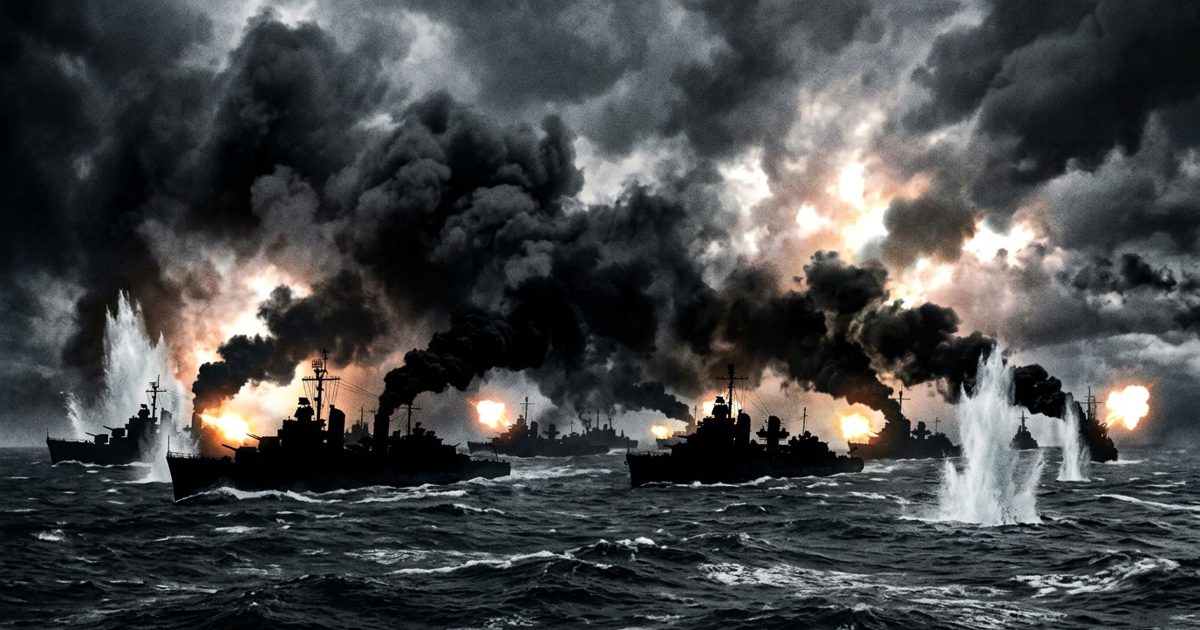
Warships of Task Group 16.6 patrolled frigid waters south of the Soviet Komandorski Islands to intercept Japanese reinforcements heading for occupied Kiska. Rear Admiral Charles H. McMorris led the modest American force, comprising the heavy cruiser USS Salt Lake City, the light cruiser USS Richmond, and four destroyers. Radar operators detected surface contacts at dawn, revealing an unexpected enemy force under Vice Admiral Boshiro Hosogaya. Hosogaya commanded two heavy cruisers, two light cruisers, and four destroyers, outgunning the Americans two to one. McMorris chose to accept combat immediately to protect the Aleutian supply lines.

Gunners opened fire across twenty thousand yards of rough ocean, initiating a classic daylight surface duel. Salt Lake City traded salvos with the heavy cruisers Nachi and Maya, damaging Nachi's bridge while maneuvering through shell splashes. Enemy rounds eventually penetrated Salt Lake City, flooding boiler compartments with seawater. Seawater contaminated the fuel lines and shut down every boiler, leaving the cruiser dead in the water. American engineers worked feverishly in freezing darkness to relight the burners while the remaining turrets continued firing.

Destroyers charged into enemy fire to lay protective smoke screens and mount a daylight torpedo assault. USS Bailey, USS Coghlan, and USS Monaghan closed within ten thousand yards, firing salvos that forced Hosogaya to maneuver defensively. Hosogaya feared American bombers were en route and incorrectly believed Salt Lake City remained fully combat capable. Japanese warships broke off pursuit and retreated toward Paramushir, abandoning the resupply mission. Task Group 16.6 brought the damaged cruiser home and permanently ended Japanese surface supply runs to the Aleutians.

CHRONOLOGICAL RECORD

March 27 Across U.S. Military History

8 Verified Events
1794 U.S. Navy Landmark Event • Early Republic

Naval Act Authorizes the First American Frigates

President George Washington signed the Naval Act of 1794 into law, creating the permanent naval force of the United States. Congress authorized the construction of six heavy frigates, including the future USS Constitution, to safeguard merchant commerce from North African corsairs. Construction began across six civilian shipyards, establishing the structural foundation of the U.S. Navy.

1814 U.S. Army Landmark Event • War of 1812

Andrew Jackson Wins the Battle of Horseshoe Bend

General Andrew Jackson led regular soldiers, militia, and allied warriors in an assault against a fortified Red Stick Creek stronghold along the Tallapoosa River. Jackson's force breached the log breastworks and overwhelmed the defenders in intense hand-to-hand combat. Victory effectively broke hostile Creek power and led to the Treaty of Fort Jackson.

1886 U.S. Army • American Indian Wars

Geronimo Holds Surrender Conference in Sonora

Geronimo met Brigadier General George Crook at Canon de los Embudos in northern Sonora to negotiate terms of capitulation. Geronimo agreed to surrender his band after days of parley, though he fled days later before reaching the Arizona border. General Nelson Miles subsequently assumed command to pursue the remaining Apache renegades.

1899 U.S. Army • Philippine-American War

American Troops Force Crossing of Marilao River

Soldiers of Major General Arthur MacArthur's 2nd Division attacked entrenched Filipino forces commanded directly by President Emilio Aguinaldo along the Marilao River. American infantry plunged across the deep eighty-yard waterway under heavy defensive fire to secure the northern bank. Dislodging Aguinaldo's troops opened the railway corridor for the final drive into the insurgent capital at Malolos.

1934 U.S. Navy Landmark Event • Interwar Period

Vinson-Trammell Act Launches Fleet Modernization

President Franklin D. Roosevelt signed the Vinson-Trammell Act into law, authorizing the Navy to build up to maximum strength permitted by international disarmament treaties. The legislation funded sixty-five destroyers, thirty submarines, an aircraft carrier, and over one thousand airplanes. Shipyards rapidly expanded, providing the modern naval vessels that formed the backbone of the Pacific Fleet in World War II.

1945 U.S. Army Air Forces Landmark Event • World War II

Operation Starvation Begins Aerial Mining of Japan

Boeing B-29 Superfortresses of the 313th Bombardment Wing launched from Tinian to plant naval mines throughout the Shimonoseki Strait. Flight crews dropped hundreds of parachute-retarded acoustic and magnetic mines into crucial maritime choke points. Aerial mining rapidly strangled domestic Japanese merchant shipping and severed transport corridors connecting the home islands to mainland Asia.

1945 U.S. Army • World War II

Clinton Hedrick Earns Posthumous Medal of Honor

Sergeant Clinton M. Hedrick of the 194th Glider Infantry Regiment repeatedly charged entrenched German positions during the attack on Lembeck. Hedrick eliminated several machine-gun nests and pursued enemy soldiers across a castle moat before receiving fatal wounds from an armored gun. His actions enabled his platoon to capture the town and secure vital crossroads.

1953 U.S. Navy Landmark Event • Korean War

Corpsman William Charette Shields Wounded Marines

Corpsman William R. Charette risked his life repeatedly while treating wounded Marines during an assault on Outpost Vegas. Charette Case smothered a grenade explosion with his own body, surrendered his armored vest to a patient, and braved intense mortar fire to evacuate casualties. President Dwight D. Eisenhower later presented Charette with the Medal of Honor.

TACTICAL OPERATION 1999

Combat Search and Rescue Behind Enemy Lines in Serbia

Missiles struck an American F-117A Nighthawk stealth fighter west of Belgrade during a night strike mission on March 27, 1999. Lieutenant Colonel Darrell P. Zelko ejected after an SA-3 surface-to-air missile detonated against his aircraft. Zelko concealed himself in a drainage ditch near Budanovci while Serbian search teams combed the surrounding farmland. Air Force commanders at Vicenza immediately launched an Air Force Special Operations Command rescue task force to recover him before enemy patrols discovered his hiding spot.

Helicopters penetrated Serbian airspace at treetop level to execute the tactical recovery under darkness. Flight crews flying MH-53M Pave Low and MH-60G Pave Hawk helicopters navigated hostile territory while A-10 attack planes provided armed escort. Pararescuemen secured Zelko less than eight hours after the shootdown and returned safely to Tuzla Air Base. Air Force planners subsequently revised low-observable flight routing and electronic warfare escort tactics for the duration of the air war.