Full Calendar
THIS DAY IN U.S. MILITARY HISTORY • MARCH 6 1944 U.S. Army Air Forces World War II

Eighth Air Force Strikes Berlin in Massive Daylight Bomber Assault

Major General James Doolittle dispatched over seven hundred heavy bombers and hundreds of escort fighters directly into German airspace to challenge the Luftwaffe over its capital.
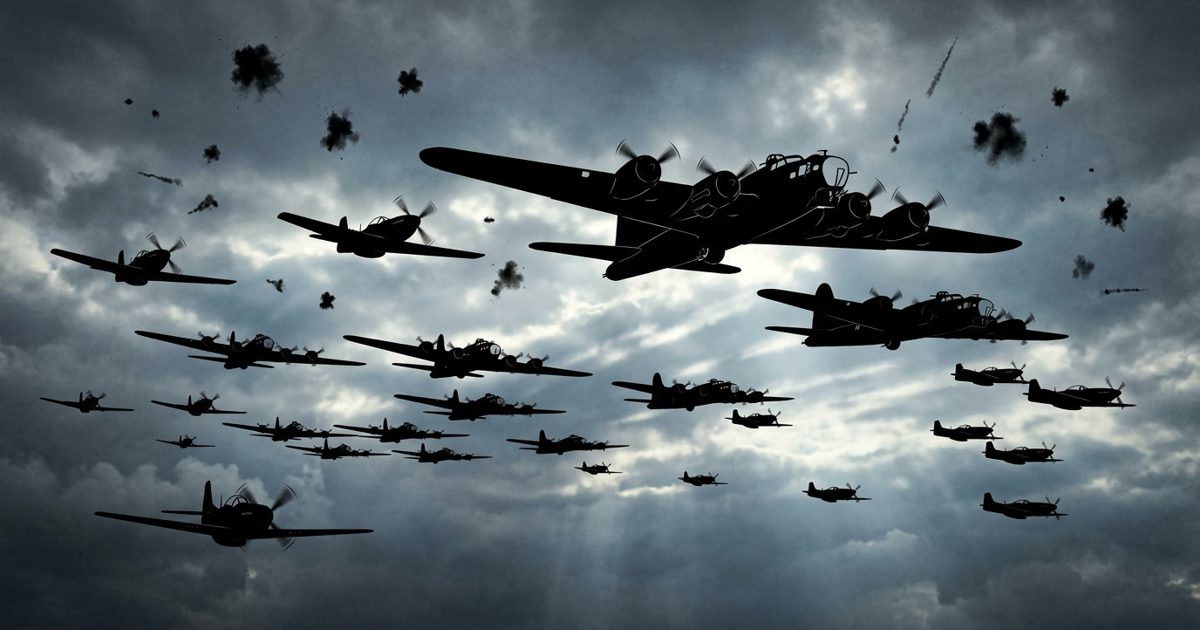
Eighth Air Force Strikes Berlin in Massive Daylight Bomber Assault

Commanders of the United States Eighth Air Force assembled the largest air strike fleet to date on March 6, 1944, dispatching 730 B-17 Flying Fortresses and B-24 Liberators toward Berlin. Fighter escorts totaling nearly eight hundred P-51 Mustangs, P-47 Thunderbolts, and P-38 Lightnings accompanied the bombers in a formation stretching nearly one hundred miles across the sky. Lieutenant General James Doolittle intended this mission to strike industrial targets including the ball-bearing plant at Erkner and to force the Luftwaffe daylight fighter force into direct combat. German air controllers tracked the massive stream across the North Sea and scrambled interceptor wings from across northwestern Europe to meet the strike.

Luftwaffe interceptors attacked the bomber streams over northwestern Germany with rocket-firing twin-engine fighters and swarms of Messerschmitt Bf 109s. American fighter groups engaged the attackers at high altitude, breaking up head-on passes and pursuing German aircraft to their home airfields. Heavy antiaircraft fire over the German capital damaged hundreds of American bombers as bombardiers dropped high explosives through broken cloud cover onto military rail yards and manufacturing facilities. Combat raged along the entire flight corridor as damaged bombers fell out of formation and defensive gunners fought running battles back toward the Dutch coast.

Losses reached severe proportions by the time returning bombers touched down on bases across East Anglia. American units lost sixty-nine heavy bombers and eleven fighter aircraft during the mission, resulting in roughly seven hundred crew members killed or captured. Ground records revealed that German fighter units lost at least sixty-six aircraft destroyed during the defensive engagements. Doolittle continued sending full-strength daylight raids against Berlin two days later, confirming that American forces could penetrate hostile airspace and steadily dismantle the front-line defensive capability of the German air arm.

CHRONOLOGICAL RECORD

March 6 Across U.S. Military History

9 Verified Events
1781 Continental Army Landmark Event • American Revolutionary War

Continental Troops Check British Advance at Weitzels Mill

Colonel Otho Holland Williams deployed Continental light infantry and cavalry to defend the crossing at Reedy Fork Creek on March 6, 1781. Lieutenant Colonel Banastre Tarleton led British regulars in a rush against the American outpost to cut off Major General Nathanael Greene from his reinforcements. Williams fought a fierce delaying action at the mill ford before withdrawing in good order, preserving the Southern Army ahead of Guilford Courthouse.

1822 U.S. Navy • West Indies Anti-Piracy Operations

USS Enterprise Captures Four Pirate Vessels off Cuba

Lieutenant Lawrence Kearney steered the schooner USS Enterprise into waters off Cape Antonio, Cuba, on March 6, 1822. Bluejackets boarded and seized four armed pirate vessels operating against American merchant shipping in the Caribbean. Kearney destroyed the pirate flotilla and escorted captured vessels to port, securing vital trade routes through the Gulf of Mexico.

1862 U.S. Army Landmark Event • Civil War

Union Forces Repel Confederate Pursuit at Bentonville

Brigadier General Franz Sigel organized a fighting withdrawal from Bentonville, Arkansas, on March 6, 1862, during the opening maneuvers of Pea Ridge. Confederate cavalry under Major General Earl Van Dorn attempted to encircle the detachment before it could unite with the main force. Sigel deployed horse artillery to break the Confederate pursuit, allowing his division to reach Sugar Creek intact.

1862 U.S. Navy Landmark Event • Civil War

USS Monitor Departs New York Bound for Hampton Roads

Lieutenant John Lorimer Worden took the newly commissioned ironclad USS Monitor out of New York harbor on March 6, 1862. Towed by the steam tug Seth Low, the experimental low-freeboard warship endured heavy swells while steaming toward Virginia. Worden arrived two days later just in time to engage the Confederate ironclad CSS Virginia.

1865 U.S. Army • Civil War

United States Colored Troops Assault Confederate Lines at Natural Bridge

Soldiers of the 2nd and 99th U.S. Colored Infantry assaulted entrenched Confederate positions along the St. Marks River on March 6, 1865. Brigadier General John Newton directed repeated attacks across the riverbed to open an advance on Tallahassee. Confederate artillery repulsed the crossings after daylong fighting, forcing Union columns to withdraw under the cover of naval gunboats.

1943 U.S. Navy Landmark Event • World War II

Task Force Sixty-Eight Sinks Two Japanese Destroyers at Blackett Strait

Rear Admiral Aaron Merrill led Task Force 68 into the Solomon Islands to bombard enemy shore positions on March 6, 1943. Radar operators aboard the cruiser USS Montpelier spotted two Japanese destroyers exiting Blackett Strait without visual contact. Cruisers and destroyers fired radar-directed salvoes, sinking both Murasame and Minegumo within minutes before completing their shore bombardment mission.

1951 U.S. Army • Korean War

Private Leonard Kravitz Stands Alone Against Enemy Onslaught

Private First Class Leonard Kravitz took control of an abandoned machine gun during a massive night assault near Yangpyeong on March 6, 1951. Kravitz voluntarily remained behind when enemy forces broke through the perimeter, laying down continuous suppressive fire so his platoon could retreat. Relief forces later found him dead behind his weapon, surrounded by enemy casualties.

1965 U.S. Navy • Cold War

Sikorsky Sea King Completes Nonstop Transcontinental Flight

Commander James Williford lifted a Sikorsky SH-3A Sea King from the deck of USS Hornet at San Diego on March 6, 1965. Crew members managed fuel consumption over 2,105 miles, touching down aboard USS Franklin D. Roosevelt off the Florida coast after nearly seventeen hours aloft. The flight established a world distance record for rotary-wing aircraft.

1966 U.S. Army Landmark Event • Vietnam War

First Cavalry Division Concludes Operation Masher White Wing

Major General Harry Kinnard terminated Operation Masher and White Wing across Binh Dinh Province on March 6, 1966. First Cavalry Division troopers carried out forty-one days of airmobile search-and-destroy combat, disrupting the 3rd North Vietnamese Army Division along the Bong Son plain. Helicopter assaults and concentrated artillery secured coastal communications corridors before units returned to base.

WEAPONS AND TECHNOLOGY 1945

Pershing Tank Vanquishes German Panther at Cologne Cathedral

Corporal Clarence Smoyer operated the 90-millimeter gun of an M26 Pershing heavy tank during the street fight in Cologne on March 6, 1945. Smoyer and his crew from the 32nd Armored Regiment advanced toward the cathedral after a concealed German Panther destroyed two M4 Shermans. Sergeant Robert Early ordered the Pershing driver into the open intersection to prevent the German crew from targeting them in a narrow bottleneck.

Smoyer fired on the move, striking the Panther beneath its gun mantlet and quickly following with two armor-piercing rounds through the side hull. Secondary explosions engulfed the German tank in fire, eliminating the last major obstacle in the cathedral square. Cameraman Jim Bates recorded the entire thirty-second duel from a damaged apartment window, preserving an unedited record of American heavy armor defeating late-war German panzers in urban combat.