Full Calendar
THIS DAY IN U.S. MILITARY HISTORY • MARCH 5 1776 Continental Army American Revolutionary War

Continental Army Fortifies Dorchester Heights Overlooking Boston

General George Washington deployed artillery and prefabricated defenses overnight to seize the heights and compel the British evacuation of Boston in 1776.
Continental Army Fortifies Dorchester Heights Overlooking Boston

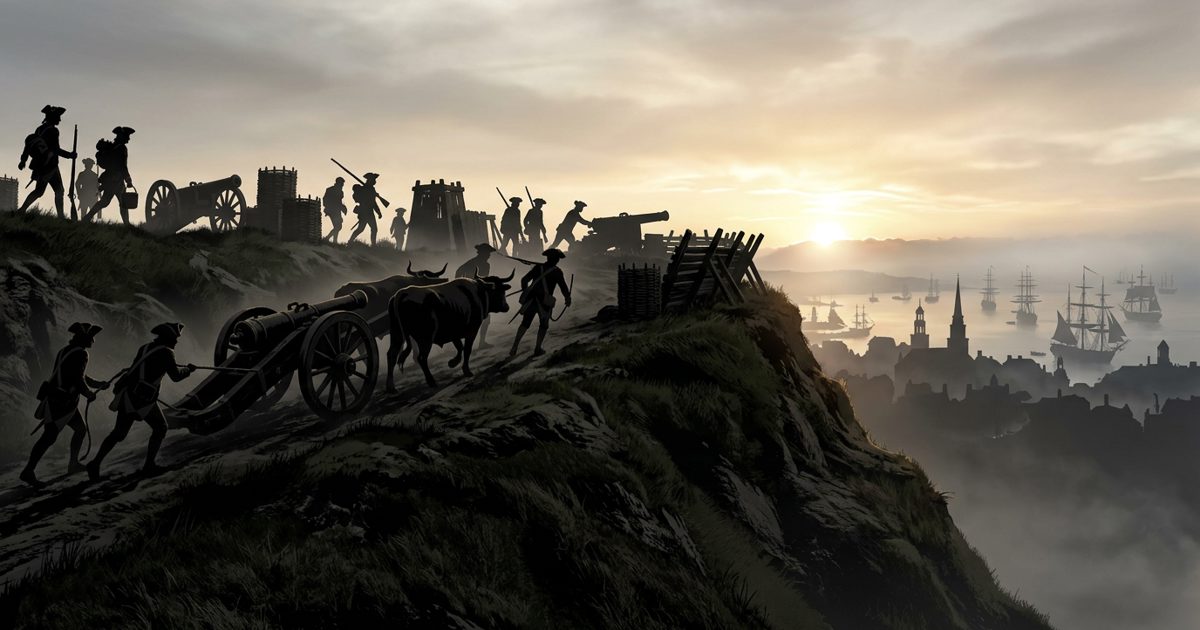
Continental Army troops under General George Washington secured the commanding bluffs of Dorchester Heights before sunrise on March 5, 1776. Brigadier General John Thomas led roughly two thousand soldiers and three hundred oxcarts carrying heavy timber frames and fascines onto the frozen summit overlooking Boston. Winter frost prevented conventional digging, prompting chief engineer Rufus Putnam to design prefabricated wooden structures that held soil and stones above the impenetrable ground. Gunners manning the freshly constructed works positioned heavy artillery dragged three hundred miles across snowbound mountains from Fort Ticonderoga by Colonel Henry Knox.

Artillery placements instantly reversed the strategic balance across the besieged seaport as the sun illuminated the American redoubts. British sentries reported the sudden appearance of twin fortifications bristling with cannon aimed squarely at the Royal Navy anchorage and garrison barracks. General William Howe expressed disbelief at the achievement, declaring that the provincial forces had completed more engineering work in a single night than his entire garrison could accomplish across months. Heavy bombardment batteries at Cambridge and Roxbury had masked the nighttime transit with diversionary salvos, keeping British forces oblivious until the defensive lines were impenetrable.

Howe assembled twenty-four hundred soldiers to launch an amphibious counterattack against the heights that afternoon before the Continentals could consolidate further. Torrential squalls and gale winds from an unexpected storm battered Boston Harbor, scattering British transport boats and aborting the assault. British commanders realized that plunging fire from the heights would shatter their fleet at anchor, forcing Howe to cancel further assaults and prepare for withdrawal. Royal Navy transports evacuated nine thousand British soldiers and over eleven hundred Loyalist refugees on March 17, 1776, surrendering Boston to Washington without another shot fired.

CHRONOLOGICAL RECORD

March 5 Across U.S. Military History

8 Verified Events
1799 U.S. Navy • Quasi-War

USS Baltimore Captures French Privateer Le Marsouin

Captain Stephen Decatur Senior led American warships USS Baltimore and USS General Greene in capturing the French privateer Le Marsouin off Havana on March 5, 1799. The armed vessel operated under the guise of a merchantman while preying on regional commerce. Decatur secured the prize vessel and escorted American merchant ships safely through Caribbean trade routes.

1862 U.S. Army • American Civil War

General Curtis Consolidates Union Defenses at Sugar Creek

Brigadier General Samuel R. Curtis issued urgent orders consolidating his divisions along Little Sugar Creek on March 5, 1862, after scout reports confirmed advancing Confederate forces. Union troops immediately began throwing up defensive earthworks and clearing fields of fire. Curtis successfully concentrated his scattered commands just hours before Confederate General Earl Van Dorn launched the Battle of Pea Ridge.

1864 U.S. Army • American Civil War

Union Forces Repel Confederate Assault at Yazoo City

Colonel James H. Coates deployed the 11th Illinois Infantry and 8th Louisiana Infantry of African Descent to defend Yazoo City, Mississippi, on March 5, 1864. Confederate cavalry assaults surrounded the town and initiated heavy street fighting. Union defenders held barricades built from cotton bales until the enemy withdrew, safeguarding key logistical corridors along the Yazoo River.

1906 U.S. Army • Moro Rebellion

Assault Begins at the First Battle of Bud Dajo

Soldiers under Colonel Joseph W. Duncan initiated artillery bombardments against fortified positions atop an extinct volcano on Jolo Island on March 5, 1906. American infantry and cavalry forces converged on the steep crater paths to suppress armed Moro resistance. The initial barrage began a three-day assault that culminated in the capture of the volcanic rim.

1942 U.S. Navy Landmark Event • World War II

Navy Officially Authorizes the Seabees Name and Insignia

Navy Department leadership officially authorized the designation Seabees and the Fighting Bee insignia for naval construction units on March 5, 1942. Admiral Ben Moreell championed the specialized battalions to replace civilian workers with military personnel capable of defending forward bases under fire. The newly designated Seabees mobilized hundreds of thousands of skilled tradesmen across global combat zones.

1943 U.S. Navy Landmark Event • World War II

USS Bogue Launches First Hunter-Killer Group Operations

Escort carrier USS Bogue sortied from Norfolk on March 5, 1943, to establish the first dedicated antisubmarine hunter-killer group in the Atlantic. Operating with five escorting destroyers and Composite Squadron 9, Bogue pioneered offensive search and attack tactics against German submarines. The task group established an operational model that ultimately destroyed thirteen enemy submarines during the war.

1945 U.S. Army Landmark Event • World War II

Third Armored Division Drives into Cologne

Major General Maurice Rose led the 3rd Armored Division into the outer streets of Cologne on March 5, 1945, spearheading Operation Lumberjack. American Shermans and new Pershing tanks cleared urban barricades while advancing in tandem with the 104th Infantry Division. The armored thrust pinned German defenders against the Rhine and captured the western half of the city within forty-eight hours.

1968 U.S. Marine Corps Landmark Event • Vietnam War

Private Ralph Johnson Earns Medal of Honor

Private First Class Ralph H. Johnson defended an observation post on Hill 146 in the Quan Duc Valley on March 5, 1968, during Operation Rock. An attacking enemy platoon tossed a live grenade into his fighting hole, threatening two comrades. Johnson hurled himself onto the explosive to absorb the detonation, saving his fellow Marines and preserving the defensive perimeter.

MILITARY AVIATION 1944

Operation Thursday Launches Allied Glider Assault into Burma

Douglas C-47 aircraft of the 1st Air Commando Group took off from India on the evening of March 5, 1944, towing Waco CG-4A gliders into northern Burma. Operation Thursday inserted assault troops from the British 77th Indian Infantry Brigade alongside the U.S. Army 900th Airborne Engineer Aviation Battalion deep behind Japanese lines. Pilots crossed eight-thousand-foot mountains in darkness before releasing gliders over a jungle clearing codenamed Broadway. Hidden logging ruts crumpled landing gliders, killing thirty men and damaging thirty-seven gliders.

Engineers unloaded miniature bulldozers from the wreckage to level obstacles and clear landing ground before sunrise. American troops worked alongside Allied soldiers through the night, filling deep trenches and clearing debris to carve out a functioning airstrip. Radio teams halted follow-on glider waves until engineers certified the runway ready for heavy aircraft. Powered C-47 transports landed safely the next evening, flying in thousands of infantrymen to sever Japanese supply lines across northern Burma.