Full Calendar
THIS DAY IN U.S. MILITARY HISTORY • DECEMBER 31 1775 Continental Army American Revolutionary War

Continental Army Assaults Quebec in a Winter Blizzard

General Richard Montgomery and Colonel Benedict Arnold lead a coordinated night attack against British fortifications in Canada.
Continental Army Assaults Quebec in a Winter Blizzard

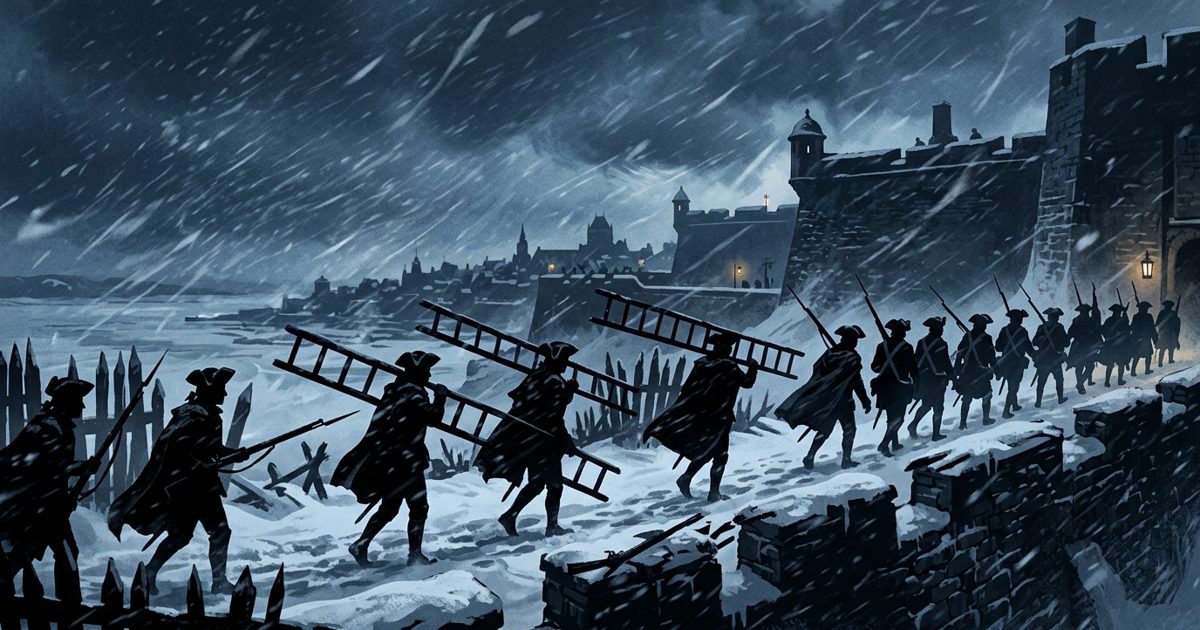
General Richard Montgomery and Colonel Benedict Arnold launched a desperate two-pronged assault on the fortified city of Quebec before dawn in a blinding snowstorm. American enlistments were set to expire at midnight, forcing the Continental Army commanders to strike before their forces dissolved. Montgomery led roughly three hundred New York infantrymen along the narrow riverside road from the south, while Arnold guided six hundred New England troops and Virginia riflemen through the snowdrifts of the lower town from the north. Both columns carried scaling ladders through deep drifts in near-zero visibility, hoping to breach the British defenses under cover of the blizzard.

Defenders spotted Montgomery's advancing vanguard as American troops approached the outer barricade at Pres de Ville. British gunners manned two concealed cannon loaded with canister shot and opened fire at point-blank range. Grapeshot tore through the leading ranks, killing General Montgomery instantly alongside his aide-de-camp and leading officers. Panic gripped the surviving New York troops, prompting Montgomery's second-in-command, Colonel Donald Campbell, to order an immediate retreat down the icy path. This withdrawal left Arnold's northern column isolated and unaware that half the assault plan had failed.

Colonel Arnold pressed his attack through the narrow streets of the Lower Town until a musket ball shattered his left leg near the Sault-au-Matelot barricade. Captain Daniel Morgan took command of the vanguard, leading his riflemen over the first wooden barrier and capturing several British defenders. Heavy return fire from surrounding stone houses pinned Morgan's men in the narrow alleys while British Governor Guy Carleton dispatched reinforcements to seal their escape route. Morgan and more than three hundred Continental soldiers surrendered after running out of dry gunpowder, ending the American attempt to capture Canada.

CHRONOLOGICAL RECORD

December 31 Across U.S. Military History

8 Verified Events
1775 Continental Army Landmark Event • American Revolutionary War

Washington Authorizes Enlistment of Free Black Soldiers

General George Washington informed Continental Congress President John Hancock that he had reversed earlier restrictions and authorized recruiting officers to enlist free African American soldiers. Black veterans with prior combat service at Bunker Hill had protested their exclusion from the reorganized Continental Army. Continental Congress subsequently approved Washington's decision, ensuring free Black soldiers served throughout the Revolutionary War.

1862 U.S. Army Landmark Event • Civil War

Army of the Cumberland Fights at Stones River

Lieutenant General William J. Hardee launched a massive dawn attack against the Union right wing outside Murfreesboro, Tennessee. Brigadier General Philip Sheridan rallied his division in a dense limestone cedar glade, delaying Confederate assaults for several hours until his ammunition ran out. Major General William S. Rosecrans stabilized the Union line along the Nashville Turnpike, securing a vital defensive perimeter.

1862 U.S. Navy Landmark Event • Civil War

Ironclad USS Monitor Sinks off Cape Hatteras

Seawater swamped the ironclad warship USS Monitor during a violent gale off the North Carolina coast. Commander John P. Bankhead ordered his crew to abandon ship as rising bilge water drowned the coal furnaces. Rescue cutters dispatched from the paddle steamer USS Rhode Island saved forty-seven sailors before the revolving-turret vessel sank.

1941 U.S. Navy Landmark Event • World War II

Admiral Chester Nimitz Assumes Pacific Fleet Command

Admiral Chester W. Nimitz took command of the United States Pacific Fleet during a simple ceremony held aboard the submarine USS Grayling at Pearl Harbor. Sunken battleships lined the damaged naval base, leaving the submarine deck as the most practical venue for hoisting his four-star flag. Nimitz retained the existing fleet intelligence staff, initiating the reconstruction of American naval combat strength.

1943 U.S. Army Air Forces • World War II

Eighth Air Force Bombs Targets Across Occupied France

Boeing B-17 Flying Fortresses of the Eighth Air Force attacked German aeronautical facilities in Paris and southwestern France. Bomb groups struck the CAM ball-bearing plant and the Hispano-Suiza engine repair depot to disrupt Luftwaffe maintenance networks. Escort squadrons of Republic P-47 Thunderbolts protected the bomber formations from German interceptors throughout the cross-channel flight.

1944 U.S. Army Landmark Event • World War II

German Forces Strike Seventh Army in Operation Nordwind

Panzergrenadiers and Volksgrenadier divisions attacked Lieutenant General Alexander Patch's U.S. Seventh Army in northeastern France just before midnight. German commanders launched Operation Nordwind across a sixty-eight-mile front in the Vosges Mountains and Alsace to exploit American lines thinned by the Ardennes fighting. Defending American units held key mountain passes and halted the German offensive after weeks of fierce combat.

1944 U.S. Army Air Forces • World War II

The Hundredth Bomb Group Battles Over Hamburg

Bombers of the 100th Bomb Group flew through intense flak and fighter swarms to attack petroleum refineries in the dockyards of Hamburg, Germany. German Focke-Wulf Fw 190 interceptors ambushed the unit after escorting fighters were drawn into separate dogfights over Lubeck. Gunners shot down several attacking planes, but twelve American B-17s were lost in the group's final major aerial battle.

1999 Joint Landmark Event • Modern Era

United States Military Transfers Panama Canal Facilities

Officials from the Department of Defense and United States Southern Command completed the formal transfer of all remaining military installations to the Republic of Panama. Treaties signed in 1977 mandated the complete turnover of forty-three American defense sites, including Howard Air Force Base and Fort Sherman. The departure concluded nearly a century of permanent American military garrison operations along the isthmus.

WEAPONS AND TECHNOLOGY 1942

Aircraft Carrier USS Essex Joins the Fleet

Shipbuilders at Newport News Shipbuilding delivered the aircraft carrier USS Essex into active service, commissioning the lead vessel of the largest class of capital ships ever constructed for the United States Navy. Designed without the restrictive limits of prewar naval treaties, the 27,100-ton warship stretched 872 feet in length and carried an air group of over ninety fighters, dive bombers, and torpedo planes. Engineers incorporated an innovative port-side deck-edge elevator alongside two centerline lifts, allowing flight deck crews to shuttle aircraft rapidly without halting catapult launches. Heavy defensive batteries of twelve 5-inch guns and dozens of 40-millimeter Bofors cannons shielded the flight deck from aerial assault.

Captain Donald B. Duncan accepted command as the ship began outfitting for combat operations in the Pacific theater. Essex became the tactical foundation of the fast carrier task forces, serving as Vice Admiral Marc Mitscher's flagship and spearheading strikes against Japanese bases from the Marshall Islands to Okinawa. Twenty-three sister ships followed Essex into service, overwhelming Axis sea lanes and establishing American naval aviation supremacy across the globe.